
Strategic thinking Course is the ability to look beyond immediate tasks, understand the bigger picture, evaluate different possibilities, and make decisions that support long-term goals. It helps leaders connect current actions with future outcomes while considering risks, opportunities, people, resources, and changing business conditions.
Whether you are a team leader, manager, entrepreneur, or aspiring executive, strategic thinking can help you make more thoughtful decisions instead of reacting only to what is happening today.
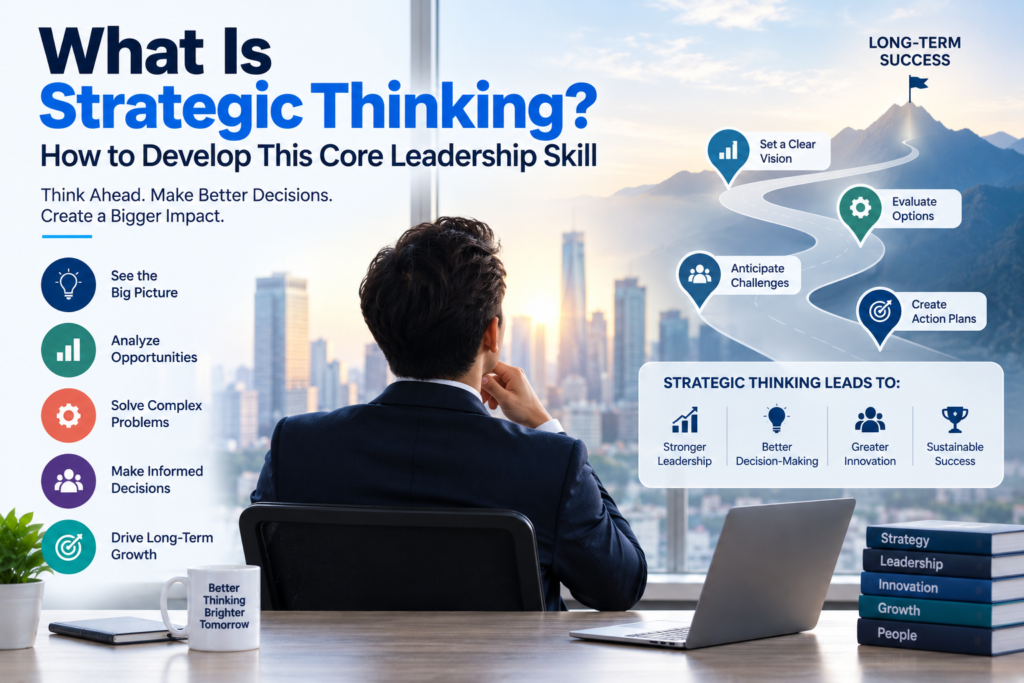
What Is Strategic Thinking?
Strategic thinking is a way of approaching problems and decisions with a long-term, big-picture perspective.
Instead of focusing only on “What should we do right now?”, strategic thinkers also ask:
- Where are we trying to go?
- Why is this important?
- What could change in the future?
- What opportunities are we missing?
- What risks could affect our plans?
- How will today’s decision affect tomorrow’s results?
Strategic thinking does not mean predicting the future perfectly. It means preparing for different possibilities and making informed choices based on available evidence.
Why Is Strategic Thinking Important?
Organizations operate in environments that can change quickly. Customer expectations, technology, competition, regulations, and market conditions can all influence business performance.
Strategic thinking helps professionals step back from day-to-day activities and consider what really matters.
Strategic Thinking Helps Leaders See the Bigger Picture
A manager may be focused on achieving this month’s sales target. A strategic thinker will also consider whether the current sales approach can continue to work over the next year.
This broader perspective helps connect short-term actions with long-term objectives.
It Supports Better Decision-Making
Strategic thinking encourages people to consider multiple options before making an important decision.
Rather than choosing the quickest solution, leaders can evaluate:
- Potential benefits
- Possible risks
- Available resources
- Long-term consequences
- Stakeholder needs
- Alternative approaches
It Helps Identify Opportunities
Strategic thinkers pay attention to changes in customer behavior, technology, competitors, and the wider market.
These changes can reveal opportunities for:
- New products
- New services
- Process improvements
- New markets
- Partnerships
- Business model changes
It Helps Organizations Prepare for Uncertainty
The future is rarely predictable. Strategic thinking helps leaders prepare for different scenarios rather than depending on one expected outcome.
What Are the Key Elements of Strategic Thinking?
Strategic thinking is not one single skill. It involves several related abilities that work together.
Long-Term Perspective
Strategic thinkers consider how decisions may affect an organization over time.
They balance immediate priorities with longer-term goals.
Systems Thinking
Businesses are made up of connected functions. A change in one area can affect another.
For example, reducing customer support costs might improve short-term expenses but could also affect customer satisfaction and retention.
Systems thinking helps leaders consider these connections.
Critical Thinking
Strategic decisions require questioning assumptions and examining information carefully.
Instead of accepting an idea because it sounds attractive, strategic thinkers ask:
What evidence supports this idea?
What assumptions are we making?
What could we be overlooking?
Scenario Thinking
Scenario thinking involves considering different possible futures.
For example:
- What happens if the market grows?
- What happens if demand decreases?
- What happens if a major competitor changes its strategy?
- What happens if costs increase?
Thinking through these possibilities can help organizations prepare more effectively.
Prioritization
Organizations have limited time, money, people, and attention.
Strategic thinking involves deciding which activities are most important and which can wait.
Adaptability
A strategy should not become so rigid that it cannot respond to changing circumstances.
Strategic thinkers are willing to adjust their approach when new information becomes available.
How to Develop Strategic Thinking Skills
Strategic thinking can be developed through regular practice. You do not need to be a senior executive to start building this skill.
1. Start With the Bigger Picture
When working on a task, avoid looking at it in isolation.
Ask yourself:
- What business goal does this support?
- Who benefits from this work?
- How does it connect with other activities?
- What happens if we do not do it?
This helps you connect individual tasks with broader objectives.
2. Ask Better Questions
Good strategic thinking starts with good questions.
Instead of asking only:
How can we solve this problem?
Try asking:
Why does this problem exist in the first place?
Other useful questions include:
- What are we trying to achieve?
- What assumptions are we making?
- What alternatives do we have?
- What could happen next?
- What information are we missing?
- What would make this strategy fail?
3. Learn to Look for Patterns
Strategic thinkers pay attention to patterns rather than isolated events.
For example, one month of declining sales may not tell you much. But a consistent decline across several months, combined with changing customer behavior, could indicate a larger issue.
Look for patterns in:
- Customer behavior
- Sales
- Costs
- Competitor activity
- Employee performance
- Market trends
- Technology
4. Think in Scenarios
You can improve strategic thinking by regularly considering different possible outcomes.
A simple exercise is to identify:
Best case: What happens if everything goes well?
Expected case: What is the most realistic outcome?
Worst case: What could go seriously wrong?
Then consider what actions would make the organization more prepared for each situation.
5. Understand Different Business Functions
Strategic thinking becomes stronger when you understand how different parts of a business work together.
Learn the basics of:
- Finance
- Marketing
- Sales
- Operations
- Human resources
- Customer experience
- Technology
For example, a marketing decision can influence sales, customer acquisition costs, revenue, and operations.
6. Study Business Trends
Make a habit of understanding what is changing in your industry.
Pay attention to:
- Emerging technologies
- Customer expectations
- Competitor strategies
- Economic changes
- Regulatory developments
- New business models
The objective is not to follow every trend. It is to understand which changes could genuinely affect your organization.
7. Challenge Your Own Assumptions
One of the biggest barriers to strategic thinking is assuming that what worked in the past will always work in the future.
Before making an important decision, ask:
What if our current assumption is wrong?
This simple question can uncover risks and alternative approaches.
8. Practice Connecting Actions to Outcomes
When making a decision, think beyond the immediate result.
For example:
Action → Immediate result → Secondary effect → Long-term impact
This approach helps you recognize consequences that may not be obvious at first.
9. Learn From Past Decisions
After completing an important project or making a major decision, review the outcome.
Ask:
- What worked?
- What did not work?
- Which assumptions were correct?
- Which assumptions were wrong?
- What would we do differently next time?
Reflection turns experience into learning.
10. Discuss Ideas With Different People
Strategic thinking improves when you hear perspectives outside your own area of expertise.
Talk to people from different departments and ask how they see a particular business problem.
Different perspectives can reveal risks or opportunities you may have missed.
Strategic Thinking vs Tactical Thinking
Strategic and tactical thinking are both important, but they focus on different levels.
| Strategic Thinking | Tactical Thinking |
|---|---|
| Focuses on long-term direction | Focuses on immediate execution |
| Looks at the bigger picture | Focuses on specific tasks |
| Considers future possibilities | Concentrates on current priorities |
| Evaluates broader consequences | Implements planned actions |
| Asks “Where should we go?” | Asks “How do we get this done?” |
The two approaches should work together.
A strong strategy without effective execution will not produce results. Likewise, excellent execution without a clear direction can lead to wasted resources.
What Are Examples of Strategic Thinking in the Workplace?
Strategic thinking can appear in everyday business decisions.
Example 1: Declining Customer Retention
A company notices that customers are leaving.
A tactical response might be to offer discounts immediately.
A strategic approach would investigate:
- Why customers are leaving
- Which customer groups are most affected
- Whether competitors are offering better experiences
- Whether product quality has changed
- Whether customer expectations have shifted
The goal is to address the underlying issue rather than only the immediate symptom.
Example 2: Introducing New Technology
A company wants to adopt a new AI tool.
Instead of asking only whether the technology is impressive, strategic thinkers consider:
- What business problem will it solve?
- What will implementation cost?
- How will employees use it?
- What risks could it create?
- How will success be measured?
- Is the technology aligned with the organization’s long-term goals?
Example 3: Entering a New Market
Before entering a new market, leaders may evaluate:
- Customer demand
- Competition
- Pricing
- Regulations
- Distribution
- Operational requirements
- Financial risks
This broader analysis can help determine whether expansion makes sense.
What Skills Support Strategic Thinking?
Strategic thinking works best when combined with other professional skills.
Communication
A good strategy needs to be explained clearly so that people understand the direction and their role in achieving it.
Data Literacy
Data can provide evidence for strategic decisions. Professionals should be comfortable interpreting relevant information and distinguishing useful signals from noise.
Problem-Solving
Strategic challenges are often complex and do not have one obvious answer.
Leadership
Leaders need to bring people together around shared objectives and help teams move from strategy to execution.
Decision-Making
Strategic decisions often involve incomplete information. The ability to evaluate options and make reasoned choices is therefore essential.
How Can Managers Build Strategic Thinking in Their Teams?
Strategic thinking should not be limited to senior executives.
Managers can encourage it by asking employees to think beyond individual tasks.
For example, instead of simply assigning a task, a manager can explain:
- Why the task matters
- Which business objective it supports
- How success will be measured
- What potential risks exist
Managers can also encourage employees to suggest improvements and explain the reasoning behind their recommendations.
This creates a culture where people think about outcomes rather than simply completing instructions.
What Are Common Barriers to Strategic Thinking?
Even experienced professionals can struggle to think strategically.
Too Much Focus on Daily Tasks
Constantly dealing with urgent work can leave little time for planning and reflection.
Short-Term Thinking
Focusing only on immediate results can cause organizations to overlook long-term consequences.
Confirmation Bias
People may look for information that supports what they already believe.
Lack of Data
Poor-quality or incomplete information can make strategic decisions more difficult.
Resistance to Change
A strategy that worked previously may not remain effective when circumstances change.
Recognizing these barriers is the first step toward overcoming them.
Is Strategic Thinking a Leadership Skill?
Yes. Strategic thinking is an important leadership capability because leaders often need to make decisions that affect teams and organizations over longer periods.
However, strategic thinking is not limited to people with management titles.
Employees at different levels can demonstrate strategic thinking by:
- Understanding business objectives
- Identifying opportunities
- Anticipating risks
- Questioning inefficient processes
- Connecting their work to wider goals
- Suggesting practical improvements
Developing these habits can help professionals prepare for greater responsibility.
How Can You Measure Strategic Thinking?
Strategic thinking is difficult to measure with a single test or number. It is often reflected in the quality of decisions and outcomes.
Some useful indicators include:
- Quality of strategic decisions
- Ability to identify risks early
- Alignment between actions and business goals
- Ability to recognize opportunities
- Quality of long-term planning
- Effectiveness of resource prioritization
- Ability to adapt when conditions change
Feedback from managers, colleagues, and stakeholders can also help identify areas for improvement.
Frequently Asked Questions
What is strategic thinking in simple terms?
Strategic thinking means looking at the bigger picture, considering future possibilities, and making decisions that support long-term goals.
Why is strategic thinking important?
It helps professionals make better decisions, identify opportunities, anticipate risks, and connect everyday actions with broader organizational objectives.
Can strategic thinking be learned?
Yes. It can be developed through activities such as scenario planning, asking better questions, studying business trends, challenging assumptions, and learning from previous decisions.
What are the key skills of strategic thinking?
Important skills include critical thinking, long-term planning, problem-solving, prioritization, adaptability, systems thinking, decision-making, and communication.
What is the difference between strategic and tactical thinking?
Strategic thinking focuses on direction, long-term objectives, and broader consequences. Tactical thinking focuses more on how to execute specific activities and achieve immediate objectives.
Is strategic thinking only for managers?
No. Professionals at different career levels can use strategic thinking by understanding organizational goals, anticipating problems, identifying opportunities, and connecting their work to wider business outcomes.
How can I improve my strategic thinking skills?
Start by looking beyond immediate tasks. Ask why a problem exists, consider multiple possible outcomes, learn about different business functions, study industry changes, and regularly reflect on your decisions.
What is an example of strategic thinking?
If sales are declining, strategic thinking involves investigating the underlying causes, customer behavior, market conditions, competition, and long-term implications rather than immediately applying a short-term fix.
Final Thoughts
Strategic thinking is about seeing beyond the immediate situation and making decisions with the future in mind. It helps professionals understand how individual decisions can influence customers, teams, resources, and long-term business performance.
You can develop this skill gradually. Start by asking better questions, challenging assumptions, studying patterns, considering different scenarios, and connecting everyday work with broader goals.
For aspiring leaders, strategic thinking is particularly valuable because effective leadership is not only about managing today’s responsibilities—it is also about preparing for what comes next.

Comments (2)
[…] Basic statistical analysis […]
[…] Analytics allows businesses to turn data into useful information for operational and strategic decision-making. […]