
Businesses today are changing rapidly as technology becomes an essential part of everyday operations. From artificial intelligence and cloud computing to automation, analytics, and digital collaboration, organizations are adopting new technologies to improve the way they work and serve their customers.
This broader process is known as digital transformation.
Digital transformation is not simply about purchasing new software or moving business information online. It involves rethinking processes, improving customer experiences, using data more effectively, developing employee capabilities, and applying technology to achieve measurable business goals.
For professionals and organizations in markets such as the United States and India, understanding digital transformation can help create new opportunities for efficiency, innovation, and long-term growth.
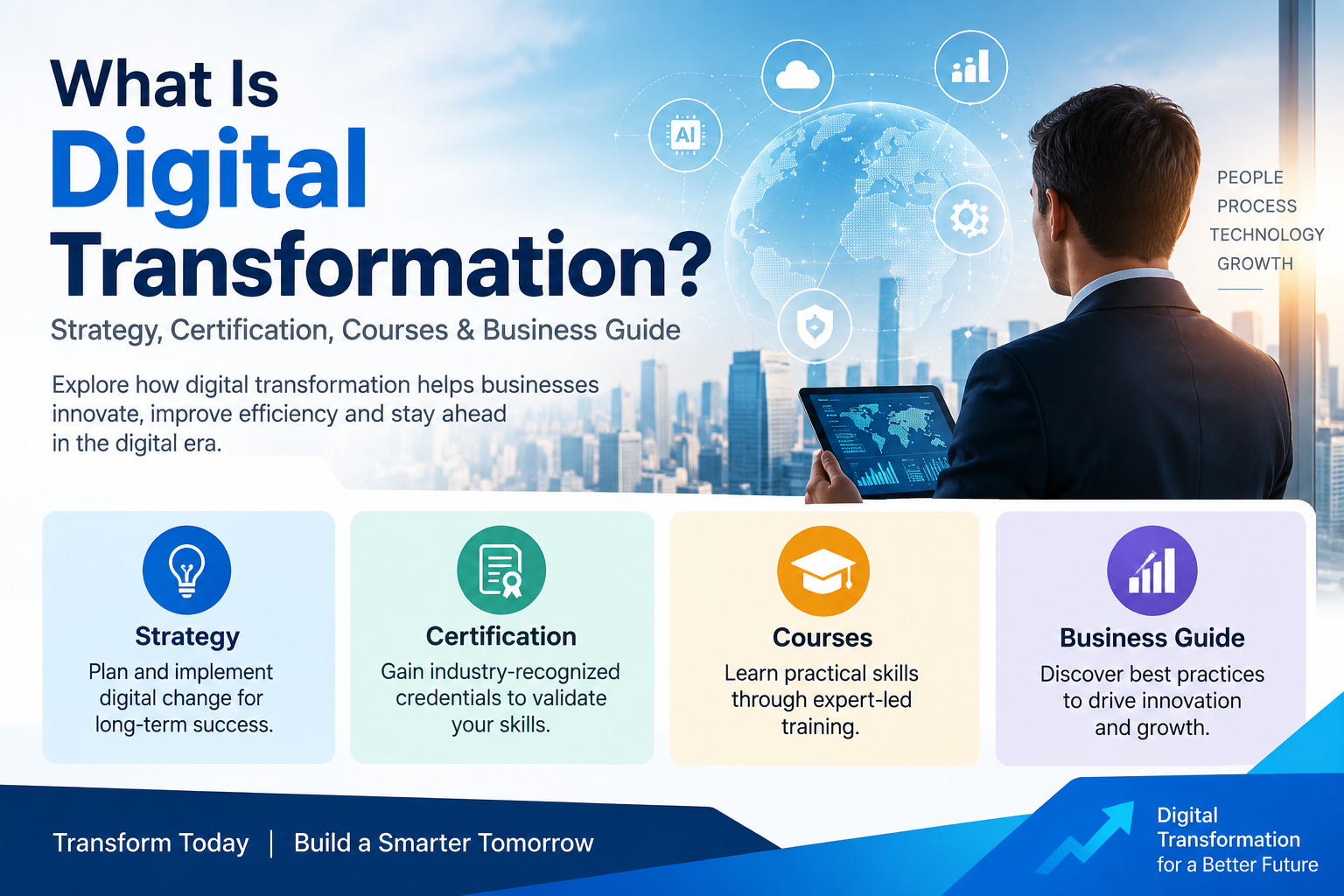
Table of Contents
What Is Digital Transformation?
Digital transformation is the process of using digital technologies to improve business operations, customer experiences, decision-making, products, services, and organizational processes.
It can involve technologies such as:
- Artificial intelligence
- Cloud computing
- Data analytics
- Business automation
- Digital collaboration platforms
- Customer relationship management systems
- Application programming interfaces (APIs)
- Cybersecurity solutions
- Digital communication platforms
However, technology is only one part of transformation.
A successful Digital transformation also requires changes in business processes, employee skills, leadership, organizational culture, and decision-making.
For example, a company may introduce an AI-powered customer service system. The technology itself is not the complete transformation. The organization may also need to redesign customer service workflows, train employees, establish quality controls, protect customer information, and measure whether the new system improves customer satisfaction.
Why Is Digital Transformation Important for Businesses?
Customer expectations, competition, technology, and market conditions continue to evolve. Businesses therefore need the ability to adapt quickly.
A well-planned digital transformation can help organizations improve several areas of their business.
Improve Operational Efficiency
Digital tools can reduce repetitive manual tasks and simplify complex workflows.
Automation can be used for activities such as reporting, data processing, notifications, approvals, and routine administrative work.
This allows employees to spend more time on activities that require problem-solving, creativity, communication, and decision-making.
Improve Customer Experience
Customers increasingly expect businesses to provide fast, convenient, and personalized experiences.
Digital platforms can help organizations understand customer needs, communicate more effectively, and provide services through multiple digital channels.
Make Better Use of Data
Modern organizations generate large amounts of information.
Digital transformation can help businesses collect, organize, analyze, and use this information to support better decisions.
Data dashboards, analytics platforms, and AI-assisted tools can help leaders understand trends and identify opportunities.
Support Innovation
Digital technologies can make it easier for businesses to experiment with new products, services, processes, and business models.
Organizations can test ideas, collect feedback, and improve their offerings based on evidence.
Increase Business Agility
A digitally capable organization can respond more quickly to changing customer expectations and market conditions.
This flexibility is particularly important for businesses operating in competitive and rapidly changing industries.
What Is a Digital Transformation Strategy?
A digital transformation strategy is a structured plan that explains how an organization will use technology and organizational capabilities to achieve specific business objectives.
Instead of adopting technology simply because it is new, businesses should first identify the problem they want to solve.
For example:
Business problem → Digital solution → Implementation → Measurement → Improvement
A digital transformation strategy may address areas such as:
- Business process improvement
- Technology adoption
- Data management
- Customer experience
- Employee productivity
- Automation
- AI adoption
- Cloud migration
- Cybersecurity
- Organizational change
Key Components of a Digital Transformation Strategy
1. Business Objectives
The organization should identify what it wants to achieve.
Possible objectives include improving productivity, reducing operational costs, increasing customer satisfaction, or creating new digital services.
2. Current-State Assessment
Before introducing new technology, businesses should understand their existing processes, systems, data, and workforce capabilities.
3. Technology Assessment
Organizations can then evaluate which technologies are appropriate for their specific business needs.
4. Employee Skills
Employees need the knowledge and confidence to use new technologies effectively.
Training and professional development should therefore be part of the transformation strategy.
5. Change Management
Technology can change established workflows and responsibilities. Effective communication and change management can help employees adapt.
6. Measurement
Transformation initiatives should have measurable outcomes.
Businesses can track metrics such as productivity, processing time, customer satisfaction, operational costs, adoption rates, and revenue impact.
Digital Transformation vs. Business Transformation
Digital transformation and business transformation are closely related, but they are not exactly the same.
Business transformation focuses on significant changes to how an organization operates, creates value, competes, or serves customers.
Digital transformation uses digital technologies as an important part of those changes.
For example, a company might transform its customer service model by introducing self-service platforms, AI-supported customer assistance, data analytics, and automated workflows.
The broader objective is business improvement, while digital technology enables part of that transformation.
Technologies Supporting Digital Transformation
Different organizations require different technologies, but several areas are commonly associated with digital transformation.
Artificial Intelligence
AI can support data analysis, content creation, forecasting, customer service, decision support, and workflow automation.
Cloud Computing
Cloud platforms provide organizations with flexible access to computing infrastructure, applications, storage, and digital Transformation services.
Data Analytics
Analytics allows businesses to turn data into useful information for operational and strategic decision-making.
Automation
Automation can connect business processes and reduce repetitive manual activities.
APIs and System Integration
APIs allow different applications and platforms to communicate with each other, creating more connected digital environments.
Cybersecurity
As businesses become more dependent on digital systems, protecting data, applications, networks, and users becomes increasingly important.
What Skills Are Needed for Digital Transformation?
Digital transformation requires a combination of business, technology, analytical, and interpersonal skills.
Important areas include:
- Digital strategy
- Business process improvement
- Technology awareness
- Data literacy
- Artificial intelligence awareness
- Cloud literacy
- Automation
- Project management
- Change management
- Strategic thinking
- Stakeholder communication
- Problem-solving
- Risk awareness
- Technology adoption
Professionals do not necessarily need to become experts in every technology.
Instead, they should understand how different technologies can address business problems and how organizations can successfully adopt them.
Digital Transformation in the United States
Businesses in the United States operate across highly competitive and technology-driven industries.
Organizations in sectors such as finance, healthcare, retail, manufacturing, education, technology, logistics, and professional services are exploring digital technologies to improve operations and customer experiences.
For professionals in the United States, digital transformation skills can be relevant to careers involving technology adoption, business analysis, operations, project management, strategy, analytics, and organizational change.
Professionals considering a digital transformation certification can look for programs that combine technology knowledge with practical business applications rather than focusing exclusively on individual software tools.
A digital transformation course can also help professionals build foundational knowledge in areas such as AI, automation, cloud technology, analytics, and digital Transformation strategy.
Digital Transformation in India
India has developed a rapidly expanding digital Transformation economy, with organizations across technology, finance, retail, education, healthcare, manufacturing, and professional services adopting digital technologies.
Businesses in India are using technologies such as AI, cloud computing, analytics, automation, and digital platforms to improve processes and create new customer experiences.
For Indian professionals, understanding digital transformation can be useful across both technical and non-technical roles.
A digital transformation course in India can help professionals understand how technology, data, processes, and organizational change work together.
Professionals may also consider a digital transformation certification in India as part of their professional development, particularly if they want to demonstrate knowledge of digital transformation concepts and business applications.
What Is a Digital Transformation Certification?
A digital transformation certification is a professional credential that demonstrates knowledge or competency related to digital transformation concepts, technologies, strategies, or business applications.
The content of certification programs can vary significantly.
When evaluating a digital transformation certification, professionals should consider whether the program covers areas such as:
- Digital transformation strategy
- Business process improvement
- Technology adoption
- AI and automation
- Data and analytics
- Cloud technologies
- Change management
- Digital transformation business models
- Strategic decision-making
A useful credential should help learners understand not only what technologies exist, but also how they can be applied to real organizational challenges.
How to Choose a Digital Transformation Course
There are many digital Transformation learning programs available, so professionals should evaluate a digital transformation course based on their career goals and existing knowledge.
Consider the following factors:
Course Relevance
Does the course cover the digital transformation skills relevant to your current or future role?
Practical Application
Does the learning help you understand how digital Transformation can solve business problems?
Business Perspective
Does the course connect technology with strategy, operations, customers, employees, and organizational objectives?
Professional Recognition
Consider whether the credential provides a clear description of the competencies or knowledge you are expected to develop.
Flexibility
Professionals may prefer learning formats that allow them to develop skills alongside their existing work or education commitments.
Career Opportunities in Digital Transformation
Digital transformation creates opportunities across technology, business, operations, analytics, and strategy.
Possible career areas include:
- Digital Transformation Specialist
- Digital Transformation Manager
- Technology Adoption Manager
- Business Analyst
- Digital Strategy Professional
- Business Transformation Consultant
- Process Improvement Specialist
- Automation Specialist
- Data Analyst
- Project Manager
- Change Management Professional
- Technology Strategy Advisor
The responsibilities associated with these roles vary by organization and industry.
Professionals from different educational and career backgrounds can develop digital transformation skills and apply them to their existing areas of expertise.
How to Develop Digital Transformation Skills
Building digital transformation capability is a continuous process.
A practical learning path can include:
Step 1: Understand Digital Business
Learn how digital technologies are changing business processes, customer experiences, products, and services.
Step 2: Build Technology Awareness
Develop foundational knowledge of AI, cloud computing, automation, analytics, APIs, and cybersecurity.
Step 3: Learn Digital Strategy
Understand how organizations evaluate technology investments and connect them with business objectives.
Step 4: Develop Data Skills
Learn how data is collected, managed, analyzed, visualized, and used for decision-making.
Step 5: Understand Change Management
Technology adoption requires people and processes to change. Learn how organizations can support employees through Digital transformation.
Step 6: Apply Your Knowledge
Look for opportunities to apply digital transformation concepts to real business problems, projects, or processes.
Build Your Digital Transformation Skills With IKON Skills
Professionals interested in developing their understanding of digital transformation can explore the IKON Skills Digital Transformation Specialist micro-credential.
The credential focuses on developing professional competencies related to digital transformation and can be relevant to professionals interested in technology adoption, business Digital transformation, digital strategy, operations, and organizational change.
Instead of learning about technology in isolation, professionals can use digital transformation knowledge to understand how technology can support broader business objectives.
Explore the IKON Skills Digital Transformation Specialist credential and develop your digital transformation skills.
Frequently Asked Questions
What is digital transformation?
Digital transformation is the process of using digital technologies, data, processes, and organizational capabilities to improve business operations, customer experiences, decision-making, and value creation.
1. Why is digital transformation important?
Digital transformation can help organizations improve efficiency, customer experience, innovation, decision-making, and adaptability.
2. What is a digital transformation strategy?
A digital transformation strategy is a structured plan for using technology and organizational capabilities to achieve measurable business objectives.
3. What is business transformation?
Business transformation involves significant changes to how an organization operates, creates value, serves customers, or competes. Digital Transformation can be an important enabler of business transformation.
4. Is a digital transformation certification useful?
A digital transformation certification can demonstrate knowledge or competencies in areas related to digital strategy, technology adoption, business transformation, and digital Transformation. Its value depends on the quality and relevance of the program.
5. What does a digital transformation course teach?
A digital transformation course may cover digital strategy, AI, automation, data analytics Course, cloud computing, technology adoption, business processes, and organizational change.
6. Can non-technical professionals learn digital transformation?
Yes. Digital transformation involves business strategy, operations, customer experience, data, leadership, and organizational change in addition to technology.
7. Is digital transformation relevant to businesses in India and the USA?
Yes. Organizations in both India and the United States use digital technologies to improve business processes, customer experiences, decision-making, and innovation. The specific priorities differ by industry and organization.
Conclusion
Digital transformation is a business-wide approach to using technology, data, processes, and people to improve how organizations operate and create value.
A successful digital transformation strategy does not begin with technology alone. It starts with a clear understanding of business objectives and then identifies the people, processes, data, and technologies required to achieve those objectives.
For professionals, developing digital transformation skills can support career opportunities across technology, analytics, operations, strategy, project management, and business transformation.
Whether you are exploring a digital transformation course, considering a digital transformation certification, or looking to strengthen your understanding of business transformation, the most valuable approach is to connect digital technology with real business outcomes.
Explore the IKON Skills Digital Transformation Specialist micro-credential to develop relevant knowledge and professional competencies for the evolving digital workplace.
