
Artificial intelligence is moving from experimentation into everyday business operations. Companies are using AI to automate repetitive work, understand customer behavior, improve forecasting, support employees, and make faster decisions.
As AI adoption grows, organizations need professionals who can manage the people, processes, technology, and business objectives behind these initiatives. This is creating demand for a new type of project professional: the AI Project Manager Course.
An AI Project Manager combines project coordination with practical knowledge of artificial intelligence, automation, data, and business strategy. They do not necessarily build AI models themselves. Instead, they help teams determine what needs to be built, why it matters, how it should be implemented, and whether it is delivering the expected results.
For professionals considering a career that combines management and emerging technology, AI project management offers an interesting path into the evolving digital workplace.
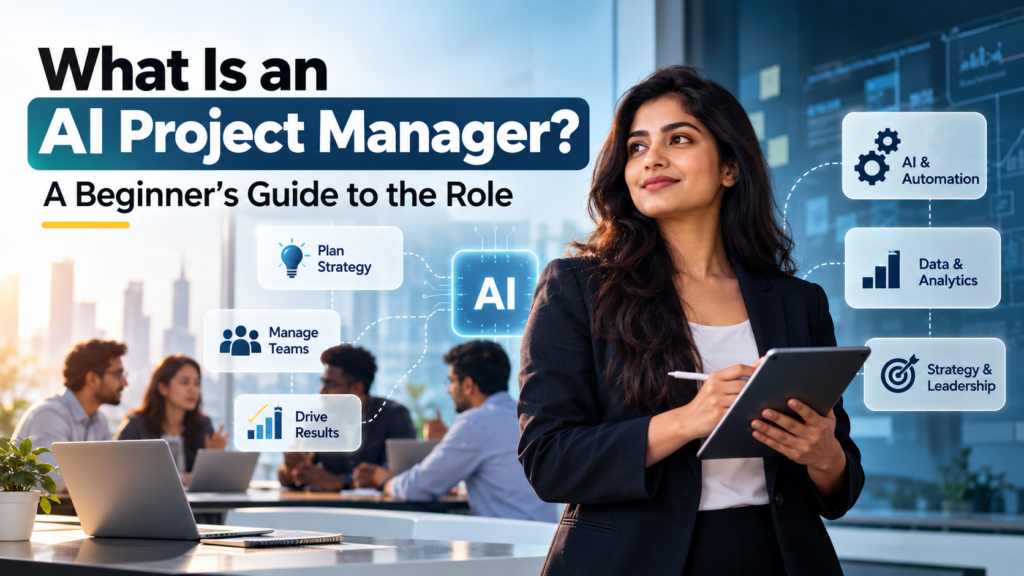
What Is an AI Project Manager?
An AI Project Manager is responsible for organizing and guiding projects where artificial intelligence plays an important role.
Their work can begin before an AI solution is selected and continue through implementation, testing, launch, and performance evaluation.
For example, a company might want to introduce an AI assistant to handle common customer questions. The AI Project Manager may help define the objective, gather requirements, coordinate the relevant teams, establish milestones, identify potential problems, and track the project’s results.
AI Project Managers may work on initiatives involving:
- Generative AI applications
- AI chatbots and virtual assistants
- Business process automation
- Predictive analytics
- Machine learning solutions
- Intelligent customer-service systems
- AI-powered marketing tools
- Data-driven business applications
- Workflow automation
- Digital transformation projects
The role can differ significantly between organizations. In some companies, the position may be closely connected to technology teams. In others, the project manager may work primarily with business, operations, product, or transformation teams.
The common responsibility is making sure an AI initiative has a clear purpose and is successfully moved from concept to useful business outcome.
Why Do Businesses Need AI Project Managers?
Implementing AI is not simply a matter of purchasing a tool and switching it on.
Organizations need to consider the problem they are trying to solve, the quality and availability of data, employee adoption, technology requirements, security, costs, expected benefits, and long-term maintenance.
Different teams may also have different expectations.
A technical team may be concerned with system performance. Employees may be concerned about usability. Legal or compliance teams may focus on privacy and responsible AI practices.
Someone needs to bring these perspectives together.
That is one of the important functions of an AI Project Manager.
They create a common direction, keep stakeholders aligned, and help ensure that an AI initiative remains connected to a genuine business requirement.
What Does an AI Project Manager Actually Do?
The daily work of an AI Project Manager can vary depending on the organization, but several activities are common.
1. Understand the Business Problem
Before selecting an AI solution, the project team needs to understand the underlying problem.
An AI Project Manager works with stakeholders to clarify questions such as:
- What process needs improvement?
- What is causing the current problem?
- Could AI realistically address it?
- Who will use the solution?
- What result would make the project successful?
This prevents organizations from adopting AI simply because the technology is available.
2. Establish the Project Scope
Once the problem is understood, the project needs clear boundaries.
A clearly defined scope can prevent an AI project from continuously expanding without a clear business outcome.
3. Bring Different Teams Together
AI initiatives can involve people from several disciplines.
A project manager may coordinate with:
- AI specialists
- Data analysts
- Data scientists
- Software developers
- Product managers
- Business analysts
- Marketing teams
- Operations teams
- Senior executives
- External technology providers
The project manager helps these groups understand how their work fits into the larger initiative.
4. Create the Project Roadmap
An AI project needs a practical sequence of activities.
The roadmap might include:
Research → Requirements → Data Preparation → Development → Testing → Deployment → Monitoring
The exact process depends on the project, but breaking the work into stages makes progress easier to manage.
5. Monitor Resources and Deadlines
Technology projects can change quickly.
An unexpected technical issue, data problem, vendor delay, or change in business requirements can affect the original plan.
The AI Project Manager tracks deadlines, dependencies, budgets, people, and resources and works with the relevant teams when adjustments are required.
6. Manage AI-Related Risks
AI introduces risks that may not appear in conventional projects.
For example, an AI system may generate unreliable outputs, perform differently across datasets, expose sensitive information, or fail to meet user expectations.
A project manager should therefore consider areas such as:
- Data quality
- Privacy
- Security
- Accuracy
- Bias
- Reliability
- Compliance
- User acceptance
- Operational costs
The project manager does not have to solve every technical problem personally. Their responsibility is to make sure that important risks are identified, discussed, assigned, and addressed.
7. Measure the Outcome
Finishing an AI project is not necessarily the same as making it successful.
After implementation, the organization needs to determine whether the solution actually improved the targeted process.
Depending on the initiative, measurements could include:
- Time saved
- Cost reduction
- Productivity
- Customer satisfaction
- User adoption
- Processing speed
- Conversion rate
- Accuracy
- Revenue impact
The right measurement depends on the original business objective.
What Skills Should an AI Project Manager Develop?
The role requires more than traditional project management knowledge.
A strong AI Project Manager typically develops skills across four major areas: management, technology, data, and leadership.
Project Management
Core project management capabilities remain important.
These include:
- Planning
- Scheduling
- Resource coordination
- Budget management
- Risk management
- Stakeholder communication
- Agile practices
- Documentation
- Problem-solving
These skills provide the foundation for managing complex initiatives.
AI Fundamentals
An AI Project Manager should understand the basic language of artificial intelligence.
Useful concepts include:
- Machine learning
- Generative AI
- Large language models
- Natural language processing
- AI automation
- AI applications
- Model evaluation
- AI limitations
The objective is not to become a machine learning engineer. It is to understand enough about the technology to ask useful questions and make informed project decisions.
Data Literacy
AI depends heavily on data.
A project manager should be comfortable discussing where data comes from, whether it is reliable, how it is interpreted, and how it affects project outcomes.
Data literacy helps project managers understand dashboards, reports, KPIs, trends, and performance measurements without needing to become full-time data scientists.
Communication
One of the most important skills is the ability to communicate technical subjects in language that business stakeholders can understand.
An AI Project Manager may need to explain a technical limitation to an executive or explain a business requirement to a technical team.
Clear communication helps reduce misunderstandings and keeps the project moving.
Leadership
AI implementation can change existing workflows and employee responsibilities.
A project manager therefore needs to help people adapt to change, address concerns, encourage collaboration, and maintain momentum throughout the project.
Does an AI Project Manager Need to Be a Programmer?
No.
Programming knowledge can certainly be useful, but an AI Project Manager does not generally need to develop machine learning models or write complex software.
Instead, they benefit from understanding the basic architecture and terminology surrounding AI projects.
For example, knowing what an API does, how data moves through a system, what an AI model is, and how automation workflows operate can make discussions with developers and AI specialists much easier.
The goal is technical understanding without necessarily becoming the technical implementation specialist.
AI Project Manager and Prompt Engineering
Generative AI has introduced another useful capability for project professionals: prompt engineering.
Prompt engineering involves creating clear instructions that help an AI system produce more useful and relevant results.
An AI Project Manager can use effective prompts to support everyday work such as:
- Creating project documentation
- Organizing meeting notes
- Drafting status updates
- Brainstorming project ideas
- Preparing stakeholder communications
- Summarizing research
- Creating initial project plans
- Reviewing large amounts of information
However, AI-generated information should still be reviewed by a human. Good project management requires judgment, context, and accountability.
For professionals building broader AI skills, an AI prompt engineering course can therefore complement knowledge of AI project management.
The Role of Data in AI Project Management
Data is one of the foundations of many AI initiatives.
If an organization wants to build an AI-powered forecasting system, recommendation engine, customer-support assistant, or predictive model, the quality of the available information can directly affect the outcome.
An AI Project Manager does not need to personally clean every dataset. However, they should understand the importance of data quality and ask the right questions.
For example:
- Where does the data come from?
- Is the information current?
- Is it complete?
- Who is responsible for it?
- Are there privacy restrictions?
- Can the data support the intended use case?
- How will success be measured?
These questions can help identify problems before they become expensive project delays.
AI Project Management and Business Strategy
Technology should support a business purpose.
A company may have access to an impressive AI system, but that does not automatically mean the implementation will create value.
An AI Project Manager helps connect the technical initiative with organizational priorities.
Consider a company experiencing long customer-service response times.
Instead of starting with the question, “Which AI tool should we buy?”, the organization could begin with:
“How can we reduce response time while maintaining service quality?”
AI might eventually be part of the solution, but the business objective comes first.
This way of thinking helps project teams evaluate AI based on outcomes rather than technology trends.
AI Project Manager vs Traditional Project Manager
The fundamentals of project management remain relevant across both roles. The main difference is the additional technology and data context involved in AI initiatives.
| Traditional Project Management | AI Project Management |
|---|---|
| Focuses on project delivery | Focuses on AI-enabled project delivery |
| Manages people, scope, budget, and deadlines | Manages these areas alongside AI and data considerations |
| Handles conventional project risks | Also considers AI, data, privacy, and model-related risks |
| Communicates project requirements | Often translates between technical and business stakeholders |
| Measures project performance | May also measure AI adoption and business impact |
An experienced project manager can therefore build toward AI Project Management by adding knowledge of AI, data, automation, and digital transformation.
Who Can Move Into AI Project Management?
AI Project Management is not restricted to people who studied computer science.
Professionals from different backgrounds may find this field relevant, including:
- Project coordinators
- Project managers
- Business analysts
- Operations professionals
- Product professionals
- Digital marketing professionals
- Technology professionals
- Consultants
- Team leaders
- Entrepreneurs
- Recent graduates
Existing professional experience can provide a useful foundation. The next step is developing enough AI and data knowledge to understand how emerging technologies can be applied to business problems.
How to Begin Learning AI Project Management
If you are new to the field, you do not need to learn everything at once.
A practical learning path could look like this:
Start With Project Management
Understand planning, scope, timelines, stakeholders, risk, resources, and project delivery.
Learn AI Fundamentals
Develop a basic understanding of machine learning, generative AI, automation, AI applications, and the limitations of AI systems.
Build Data Skills
Learn how to read and interpret data, understand KPIs, evaluate information quality, and use analytics for decision-making.
Explore Prompt Engineering
Practice using generative AI for research, documentation, brainstorming, productivity, and professional communication.
Develop Strategic Thinking
Learn to evaluate technology according to business needs, expected value, resources, risks, and long-term goals.
Work on Practical Examples
Apply your knowledge to scenarios such as customer-service automation, AI-powered reporting, workflow optimization, predictive analytics, or generative AI implementation.
Practical application is important because understanding AI terminology is different from knowing how to use AI to solve a real organizational problem.
Why AI Project Management Is Becoming a Valuable Skill
The workplace is changing as AI becomes part of everyday business operations.
Organizations are experimenting with AI in areas such as marketing, finance, customer service, operations, human resources, software development, and analytics.
This creates a need for professionals who can connect technology with execution.
AI specialists may build the technology. Business leaders may define the strategic direction. But projects still need someone who can coordinate the work, manage dependencies, communicate progress, address risks, and keep everyone focused on the desired outcome.
That is where AI Project Management can add value.
Build AI and Future-Ready Skills With IKON SKILLS™
IKON SKILLS™ provides career-focused Micro-Credentials designed around skills that are increasingly relevant in a technology-driven workplace.
Professionals interested in AI Project Management can explore related areas including AI & Automation, Data & Analytics, and Strategy & Leadership.
These areas complement one another.
AI and Automation can help learners understand how intelligent technologies can improve workflows. Data & Analytics can strengthen data-driven decision-making. Strategy & Leadership can help professionals connect technology initiatives with organizational priorities.
Professionals interested in generative AI can also explore AI Prompt Engineering as a complementary skill.
The goal is not simply to learn another technology. It is to develop a combination of practical skills that can be applied to real workplace challenges.
Explore the IKON SKILLS™ Credential Catalog to find Micro-Credentials that match your professional development goals.
Frequently Asked Questions
What is an AI Project Manager?
An AI Project Manager coordinates projects that involve artificial intelligence, automation, machine learning, or generative AI. They connect business objectives with project execution and help teams deliver AI initiatives effectively.
Is coding required to become an AI Project Manager?
Coding is not normally a mandatory requirement. However, basic knowledge of AI, software, data, APIs, and automation can help project managers communicate more effectively with technical professionals.
What should I learn to become an AI Project Manager?
Start with project management fundamentals and add AI concepts, data literacy, automation, generative AI, prompt engineering, risk management, and leadership skills.
Can a non-technical professional learn AI Project Management?
Yes. Professionals from business, operations, marketing, management, and other backgrounds can develop AI project management skills by building their understanding of AI and data alongside their existing professional experience.
Is prompt engineering useful for an AI Project Manager?
Yes. Prompt engineering can help project professionals use generative AI for research, documentation, brainstorming, communication, and other productivity tasks.
What is the difference between AI Project Management and traditional Project Management?
Both involve planning, people, resources, risks, and delivery. AI Project Management adds knowledge of artificial intelligence, data, automation, AI-related risks, and technology implementation.
Conclusion
AI Project Management is emerging as an important intersection between technology, business, people, and project execution.
The role does not require every professional to become a programmer or data scientist. Instead, it requires the ability to understand AI at a practical level and manage the people and processes needed to turn an idea into a useful solution.
For professionals preparing for the changing workplace, combining project management with AI, data literacy, automation, prompt engineering, and strategic thinking can create a strong foundation for future opportunities.
With the right learning path and practical experience, professionals from both technical and non-technical backgrounds can begin developing the capabilities needed to participate in AI-driven transformation.
Related Search Terms
- AI project manager course in India
- AI project manager course in USA
- AI project management course
- AI project management certification
- AI project manager certification
- AI project manager training
- AI project management course for beginners
- AI project management skills
- artificial intelligence project manager course
- AI project manager program
- AI prompt engineering course
- AI prompt engineering course in India
- AI prompt engineering course in USA
- prompt engineering certification
- generative AI course
- generative AI course in India
- generative AI course in USA
- AI and automation course
- data analytics course
- data literacy course
- AI leadership course
- AI strategy course
- digital transformation course
