
What Is an AI Prompt Engineer?
An AI prompt engineer is a professional who designs, tests, and improves instructions given to artificial intelligence systems to produce useful and reliable results. Their work involves understanding how AI models respond to different instructions and refining prompts to achieve better outcomes.
Prompt engineering is not simply about knowing what to type into an AI tool. It involves understanding the task, providing the right context, defining the expected output, testing different approaches, and checking whether the AI-generated result is accurate and useful.
As organizations increasingly use generative AI for content, research, customer support, software development, data analysis, and business operations, the ability to communicate effectively with AI systems has become a valuable professional skill.
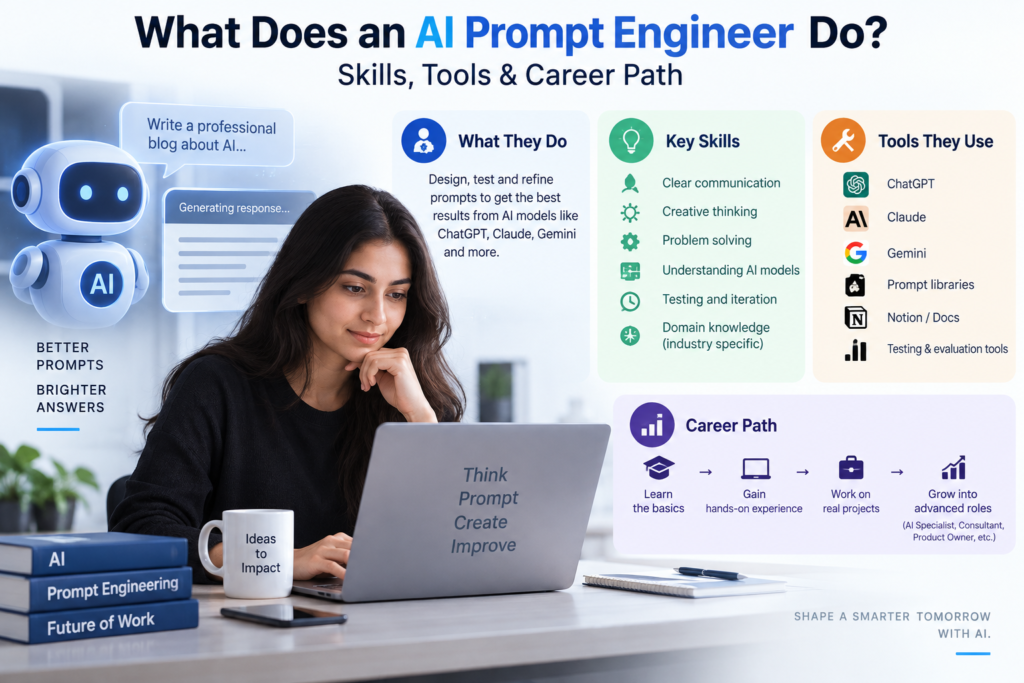
What Does an AI Prompt Engineer Do?
The day-to-day work can vary depending on the organization and industry. Some common responsibilities include:
- Designing prompts for specific business or professional tasks
- Testing different instructions to improve AI responses
- Providing relevant context and examples to AI models
- Creating reusable prompt templates and workflows
- Evaluating AI-generated responses for accuracy and relevance
- Identifying weaknesses or inconsistencies in AI outputs
- Working with teams to integrate AI into existing processes
- Documenting successful prompting methods
- Improving AI-assisted workflows over time
For example, a marketing team might need AI to create product descriptions in a particular brand voice. A prompt engineer could develop a structured instruction that provides the AI with the product information, target audience, tone, formatting requirements, and quality criteria.
Why Is Prompt Engineering Important?
AI systems can produce very different results depending on how a task is described.
Consider a simple instruction:
“Write a marketing email.”
The response may be too general because the AI has little information about the audience, product, objective, or tone.
A more structured instruction could specify:
- Who the audience is
- What product is being promoted
- The purpose of the email
- The desired tone
- The key information to include
- The preferred length
- The format of the final response
This gives the AI much more useful context.
Prompt engineering therefore helps professionals communicate tasks more clearly with AI and create more consistent outputs.
Key Skills an AI Prompt Engineer Needs
A strong prompt engineer needs more than prompt-writing ability.
1. Clear Communication
The ability to explain a task clearly is fundamental. Good instructions should remove unnecessary ambiguity and make the desired outcome understandable.
2. Critical Thinking
Prompt engineers need to question outputs, identify weaknesses, and determine whether additional information or instructions are needed.
3. Problem-Solving
A prompt may not produce the expected result on the first attempt. Professionals need to identify what went wrong and experiment with different approaches.
4. AI Literacy
Understanding basic concepts related to generative AI, language models, context, limitations, and AI outputs helps professionals create more effective workflows.
5. Domain Knowledge
Industry knowledge can be just as important as technical prompting skills. Someone working with financial information, healthcare content, education, or marketing needs to understand the relevant subject matter.
6. Testing and Evaluation
Good prompt engineering involves experimentation. Different prompts can be tested and compared to determine which approach produces the most useful results.
7. Documentation
Reusable prompts, workflows, and guidelines can save teams considerable time. Documenting what works makes it easier for others to use AI consistently.
Common Prompt Engineering Techniques
There is no single prompt formula that works for every task. However, several techniques can improve AI interactions.
Give the AI Context
Instead of providing only the task, explain the situation in which the task will be used.
Define the Desired Output
Specify whether you want a summary, table, list, email, report, explanation, or another format.
Provide Examples
Examples can help communicate the expected structure, tone, or style.
Break Complex Tasks Into Steps
Large tasks can sometimes produce better results when divided into smaller stages.
Set Constraints
You can specify requirements such as length, audience, tone, formatting, or information that should or should not be included.
Test and Refine
The first prompt is not necessarily the best prompt. Reviewing the result and improving the instructions is an important part of the process.
What Tools Do AI Prompt Engineers Use?
The tools used depend on the role and organization. Professionals may work with:
- Generative AI assistants
- Large language model platforms
- AI APIs
- Prompt management systems
- Automation platforms
- Data analysis tools
- Evaluation and testing frameworks
- Knowledge bases and internal business systems
The important skill is not memorizing a particular AI tool. Tools change quickly, so professionals benefit from understanding how to work with AI systems and evaluate their results.
AI Prompt Engineer vs AI User
These roles can overlap, but there is a difference.
An AI user may use an AI tool to complete an individual task, such as creating an email or summarizing a document.
An AI prompt engineer focuses more deliberately on designing repeatable instructions and workflows that produce reliable results for particular tasks or users.
For example:
| AI User | AI Prompt Engineer |
|---|---|
| Uses an existing prompt | Designs and improves prompts |
| Focuses on completing a task | Focuses on repeatable results |
| May use AI occasionally | May develop AI workflows |
| Reviews individual outputs | Tests and evaluates outputs systematically |
| Uses AI as a tool | Helps optimize how AI is used |
In smaller organizations, one person may perform both types of work.
A practical way to build these skills is to follow this learning path:
There is no single path into prompt engineering.
A practical learning path could look like this:
Step 1: Learn Generative AI Fundamentals
Understand what generative AI and language models can do, along with their limitations.
Step 2: Practice Writing Structured Instructions
Experiment with different ways of providing context, examples, requirements, and expected outputs.
Step 3: Work on Real Problems
Practice creating prompts for tasks such as:
- Content creation
- Research
- Data analysis
- Customer support
- Marketing
- Business reporting
- Productivity
Step 4: Learn Evaluation
Compare AI outputs and identify which prompts produce more useful, accurate, and consistent results.
Step 5: Build a Portfolio
Document practical examples showing the original problem, your approach, prompt structure, testing process, and final result.
Step 6: Develop Related Skills
Combining prompt engineering with areas such as data analytics, marketing, automation, project management, or business operations can make the skill more useful professionally.
Is AI Prompt Engineering a Good Career?
Prompt engineering can be a valuable skill, but it is better to view it as part of the broader AI skill set rather than assuming that every organization will have a dedicated “prompt engineer” position.
Many companies are incorporating AI capabilities into existing roles. Marketing professionals, analysts, project managers, developers, researchers, and business teams may all benefit from strong prompting and AI workflow skills.
For this reason, professionals can strengthen their career opportunities by combining AI prompting with domain expertise and practical business skills.
What Is the Future of Prompt Engineering?
AI systems are developing rapidly, and the way people interact with them is changing as well.
Some basic prompting tasks may become easier as AI tools improve. At the same time, organizations will continue to need people who can:
- Identify useful AI applications
- Design effective AI workflows
- Evaluate AI outputs
- Manage AI-assisted processes
- Apply AI responsibly
- Connect AI tools with business objectives
The long-term value may therefore come less from knowing a particular prompt technique and more from understanding how to use AI effectively to solve real problems.
Frequently Asked Questions
What is an AI prompt engineer?
An AI prompt engineer designs, tests, and improves instructions for AI systems to produce useful, relevant, and consistent results.
What skills does an AI prompt engineer need?
Important skills include clear communication, critical thinking, problem-solving, AI literacy, testing, evaluation, and relevant domain knowledge.
Do you need coding skills to become a prompt engineer?
Not necessarily. Some prompt-focused roles can be performed without advanced programming skills. However, coding and API knowledge can be valuable for roles involving AI automation, integrations, and technical workflows.
Is prompt engineering difficult to learn?
The basic concepts can be learned relatively quickly, but becoming effective requires practice, experimentation, evaluation, and an understanding of the specific problems being solved.
What tools do prompt engineers use?
They may use generative AI platforms, AI APIs, automation tools, prompt-management systems, evaluation frameworks, and business applications that incorporate AI.
Can prompt engineering be used in marketing?
Yes. Marketing teams can use structured prompts for content development, research, customer analysis, campaign ideas, personalization, and other workflows.
Can prompt engineering be used with data analytics?
Yes. AI can assist with tasks such as exploring datasets, explaining analytical concepts, generating queries, identifying patterns, and preparing reports. Results should still be reviewed by someone with appropriate analytical knowledge.
How can I start learning prompt engineering?
Start by learning generative AI fundamentals, practicing structured prompts, testing different approaches, evaluating outputs, and applying AI to practical professional tasks.
Final Takeaway
AI prompt engineering is about much more than writing clever prompts. It is about understanding a problem, communicating it clearly to an AI system, evaluating the result, and improving the process until the output is useful and reliable.
For professionals, the strongest approach is to combine AI prompting with an existing area of expertise. That could be marketing, analytics, project management, operations, research, or another business function.
If you want to build practical skills in this area, the AI Prompt Engineer program can be positioned as a way to develop structured prompting, AI literacy, and practical AI workflow skills.

Comment (1)
[…] A company wants to adopt a new AI tool. […]