
Project management has always involved planning, people, deadlines, budgets, risks, and decisions. Today, another capability is becoming increasingly relevant: the ability to work effectively with artificial intelligence.
An AI-Enabled Project Manager Course combines traditional project management knowledge with AI-supported tools and workflows. Instead of treating AI as a replacement for project leadership, the role focuses on using technology to improve planning, information handling, risk awareness, communication, reporting, and decision support.
For organizations, this can mean faster access to project information and more efficient workflows. For professionals, it means that project management skills are increasingly being combined with digital and AI capabilities.
This creates new learning opportunities for students, project coordinators, managers, business professionals, and career changers in India and the USA.
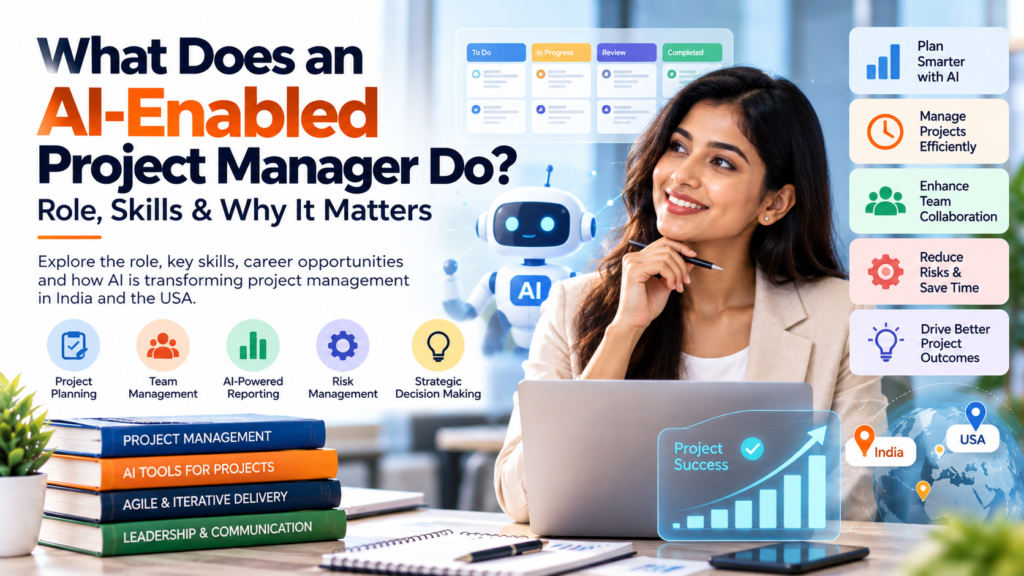
What Is an AI-Enabled Project Manager?
An AI-Enabled Project Manager is a project professional who uses artificial intelligence as part of the project management process.
The role still requires fundamental project management capabilities such as:
- Planning
- Scheduling
- Resource coordination
- Risk management
- Stakeholder communication
- Team collaboration
- Budget awareness
- Quality management
- Progress tracking
- Decision-making
AI can support some of these activities by helping organize information, identify patterns, prepare reports, generate drafts, summarize meetings, and support analysis.
The project manager remains responsible for understanding the project context, checking information, communicating with people, and making appropriate decisions.
Recent research on the emerging AI project-manager role similarly describes AI as an augmentation tool while highlighting the continuing importance of human leadership, adaptability, AI literacy, and ethical judgment.
What Does an AI-Enabled Project Manager Do?
The responsibilities depend on the organization and project, but the role can involve several important activities.
1. Uses AI to Support Project Planning
Project planning involves turning an objective into manageable activities, timelines, resources, and deliverables.
An AI-enabled project manager may use AI tools to help:
- Break large objectives into tasks
- Draft project plans
- Identify possible dependencies
- Organize project information
- Create initial schedules
- Summarize planning discussions
AI-generated suggestions still need to be reviewed against the actual project requirements.
A project manager understands the business objective and decides whether an AI-generated plan is realistic.
2. Monitors Project Progress
Keeping track of project progress can generate large amounts of information.
An AI-enabled workflow can help organize:
- Task updates
- Milestones
- Meeting notes
- Project documents
- Status reports
- Delayed activities
- Open issues
Instead of manually searching through multiple documents, a manager may use AI-supported systems to identify information that needs attention.
3. Supports Risk Identification
Projects rarely go exactly according to the original plan.
There may be:
- Delayed deliverables
- Resource shortages
- Budget changes
- Technical problems
- Vendor issues
- Changing customer requirements
- Communication gaps
AI can assist with identifying patterns or highlighting information that may deserve further investigation.
However, an AI-generated risk alert is not automatically proof that a risk exists. The project manager needs to investigate the underlying information.
4. Helps With Project Reporting
Reporting can take considerable time.
An AI-enabled project manager may use tools to prepare initial versions of:
- Weekly status reports
- Meeting summaries
- Action-item lists
- Project updates
- Executive summaries
- Progress dashboards
The manager should review the output before sharing it with stakeholders.
This creates a useful principle for AI-enabled project management:
Automate the preparation where appropriate, but retain human responsibility for the final communication.
5. Supports Stakeholder Communication
Project managers communicate with clients, employees, leadership teams, suppliers, and other stakeholders.
AI can help create different versions of a project update depending on the audience.
For example, a technical team may need detailed information about a delivery issue, while a senior executive may need a concise summary covering the impact, decision required, and next action.
The project manager still needs to understand the audience and choose the appropriate message.
6. Works With Project Data
Modern projects generate data from many sources.
An AI-enabled project manager may use data to explore:
- Project performance
- Resource utilization
- Delivery trends
- Task completion
- Schedule changes
- Cost information
- Risk indicators
Data can support better questions and decisions, but the quality of the output depends on the quality and context of the underlying information.
AI-Enabled Project Manager vs Traditional Project Manager
The fundamental objective of project management remains the same: deliver the required outcome within the agreed constraints and manage the people, risks, resources, and stakeholders involved.
The difference is often in how technology is used to perform the work.
| Traditional Project Management | AI-Enabled Project Management |
|---|---|
| Manual information gathering | AI-supported information retrieval |
| Manually prepared reports | AI-assisted report preparation |
| Experience-based analysis | Experience combined with data and AI-supported analysis |
| Manual task organization | AI-assisted planning and task organization |
| Traditional communication workflows | AI-assisted communication preparation |
| Manual document review | AI-assisted summarization and information extraction |
| Human-led decisions | Human decisions supported by technology |
This does not mean every project activity should be automated.
The right approach depends on the project, available technology, data quality, security requirements, and organizational context.
Why Is AI Important in Project Management?
Project managers often deal with large amounts of information.
A single project can involve:
- Emails
- Spreadsheets
- Meeting recordings
- Presentations
- Contracts
- Project plans
- Customer requirements
- Task-management systems
- Risk registers
- Financial information
AI can help professionals work with this information more efficiently.
The opportunity is not simply about doing tasks faster. It is also about creating more time for activities that require human judgment, such as stakeholder management, leadership, negotiation, problem-solving, and strategic thinking.
Recent project-management research describes this shift as a change in where project managers spend their attention, with routine work increasingly supported by AI while interpersonal coordination and strategic responsibilities remain important.
Skills Needed to Become an AI-Enabled Project Manager
An AI-enabled project manager needs more than knowledge of AI tools.
The role combines project management, technology, analytical thinking, and human leadership.
1. Project Management Fundamentals
Before using AI, you need to understand project management.
Important areas include:
- Project scope
- Planning
- Scheduling
- Resource management
- Risk management
- Quality
- Stakeholders
- Project reporting
AI tools are more useful when the person using them understands the underlying project-management principles.
2. AI Literacy
AI literacy means understanding what AI systems can and cannot do.
A project manager should be able to recognize:
- Appropriate AI use cases
- Limitations of AI-generated information
- Potential inaccuracies
- Data requirements
- Privacy concerns
- Human-review requirements
3. Prompt and Instruction Skills
AI tools respond to the context and instructions they receive.
A project manager may need to provide:
- Project background
- Goals
- Constraints
- Deadlines
- Stakeholder information
- Desired output format
- Relevant source material
Better instructions can produce more useful results, but prompt writing alone is not enough. Understanding the project remains essential.
4. Data Literacy
Project managers increasingly work with data.
Data literacy helps them understand:
- What a metric represents
- Where data came from
- Whether information is complete
- How trends should be interpreted
- When a result needs further investigation
5. Critical Thinking
AI can produce convincing-looking information that may still require verification.
Critical thinking helps a project manager ask:
Does this information make sense?
What evidence supports it?
What might be missing?
Could the output contain an incorrect assumption?
These questions are particularly important when AI is used for project decisions.
6. Communication
Technology does not eliminate the human side of project management.
Project managers still need to:
- Lead meetings
- Resolve disagreements
- Explain changes
- Manage expectations
- Communicate risks
- Negotiate priorities
- Build trust
Strong communication remains a core professional capability.
7. Adaptability
AI tools are developing quickly.
A tool that is common today may be replaced or significantly changed later.
Project professionals therefore need a learning mindset and the ability to adapt to new technologies and workflows.
8. Ethical and Responsible AI Use
Project managers may work with confidential business information, customer data, employee information, financial data, and intellectual property.
Before using AI with project information, professionals should understand organizational policies and applicable privacy, security, and compliance requirements.
They should also consider whether an AI-generated recommendation could contain bias, missing information, or an incorrect assumption.
How Can AI Help a Project Manager Save Time?
Consider a weekly project meeting.
Traditionally, a project manager might spend time reviewing notes, identifying action items, preparing an update, and creating a summary.
With an appropriate AI-supported workflow, the technology could assist with:
Meeting information → Summary → Action items → Draft status update
The project manager then reviews the information, checks important details, and decides what should be communicated.
This approach uses AI for preparation while keeping accountability with the human professional.
Does an AI-Enabled Project Manager Need Coding Skills?
Not necessarily.
A project manager can use many AI-enabled tools without being a programmer.
However, basic technical understanding can be useful.
Depending on the role, useful capabilities may include:
- Working with AI applications
- Understanding automation
- Using spreadsheets
- Understanding data
- Connecting business workflows
- Working with project-management platforms
- Understanding AI limitations
Advanced technical roles may require programming or data-science knowledge, but project management and AI-enabled project management should not automatically be treated as software-development roles.
What Are the Benefits of AI-Enabled Project Management?
AI can support project managers in several areas.
Better Information Handling
AI can help summarize and organize large amounts of project information.
Faster Reporting
Routine reporting tasks can be accelerated when AI is used appropriately.
Improved Visibility
AI-supported analysis can help highlight patterns or information that may deserve attention.
More Time for Leadership
Reducing some administrative work may give project managers more time for stakeholders and strategic activities.
Support for Decision-Making
AI can provide analysis or scenarios that help managers explore a problem from different perspectives.
The quality of these benefits depends on the quality of the tools, data, processes, and human oversight.
What Are the Risks of Using AI in Project Management?
AI should not be treated as an automatic solution.
Potential concerns include:
- Incorrect information
- Incomplete context
- Data privacy
- Security risks
- Bias
- Over-reliance on automated recommendations
- Poor-quality source data
- Lack of human review
For this reason, AI-enabled project management should combine automation with professional judgment.
Project Management Course: What Should You Learn?
If you are searching for a Project Managers course, look beyond basic project terminology.
A useful learning pathway can include:
- Project planning
- Scope management
- Scheduling
- Resource allocation
- Risk management
- Stakeholder coordination
- Agile approaches
- Project reporting
- Quality management
- AI-enabled project workflows
If you are already working as a project coordinator or project manager, adding AI skills can complement your existing project-management knowledge.
Project Manager Course Online
A Project Manager course online can be useful for students and working professionals who need flexible learning.
Online project-management learning can cover topics such as:
- Project planning
- Team coordination
- Risk management
- Agile delivery
- Project documentation
- Stakeholder communication
- AI tools for project work
Before choosing a program, compare the competencies, assessment method, practical activities, credential information, and learning outcomes.
A course title alone does not tell you how much practical capability you will develop.
Project Management Course in India
People searching for a project management course in India may come from different professional backgrounds.
A student may be looking for an introduction to project management, while an experienced professional may want to add AI and digital capabilities to an existing project-management skill set.
Relevant sectors in India can include:
- Information technology
- Consulting
- Construction
- Manufacturing
- Healthcare
- Education
- Financial services
- Digital businesses
- Operations
The appropriate course depends on your career stage and the type of project work you want to pursue.
Project Management Course in USA
A project management course in USA can similarly be relevant to professionals across industries.
Project-based work is found in areas such as:
- Technology
- Healthcare
- Construction
- Consulting
- Financial services
- Manufacturing
- Education
- Marketing
- Operations
If you are planning to work in the USA, check the specific requirements of the roles you are targeting. Some employers may prioritize project-management experience, while others may ask for specific certifications, industry knowledge, or technical skills.
Project Management Certificate & Training
A project management certificate & training program can help learners demonstrate structured knowledge in project management.
When comparing certificates, consider:
- Who issues the credential?
- What competencies are assessed?
- Is there a formal assessment?
- Is the learning practical?
- What level is the program?
- Can the credential support further learning?
- Is the credential relevant to your target role?
A certificate should be evaluated based on what it represents rather than the word “certificate” alone.
AI-Enabled Project Management as a Career Skill
The future of project management is not simply about replacing project managers with AI.
Instead, many professionals are learning how technology can support their existing responsibilities.
An AI-enabled project manager may become the person who connects:
Business objectives + Project teams + Data + AI tools + Human decision-making
This combination can be particularly useful as organizations introduce AI into their everyday workflows.
Research published in 2026 on the emerging AI project-manager role identified AI literacy, adaptability, leadership, emotional intelligence, and AI ethics among the competencies associated with the role, while also identifying prompt engineering as an important emerging capability.
Frequently Asked Questions
What does an AI-Enabled Project Manager do?
An AI-Enabled Project Manager manages projects while using AI-supported tools for activities such as planning, reporting, information analysis, risk support, communication preparation, and workflow improvement.
Is an AI-Enabled Project Manager different from a Project Manager?
The fundamental project-management responsibilities remain similar. The main difference is that an AI-enabled project manager incorporates AI and digital workflows into appropriate parts of project work.
Does an AI Project Manager need coding skills?
Coding is not necessarily required. However, AI literacy, data understanding, automation awareness, and familiarity with digital tools can be valuable.
What skills are required for AI-enabled project management?
Useful skills include project planning, risk management, communication, stakeholder management, AI literacy, data literacy, critical thinking, adaptability, and responsible AI use.
Can I learn AI-enabled project management online?
Yes. Online project-management training can provide a flexible way to learn project fundamentals and develop additional digital and AI-related skills.
Is a project management certificate useful?
A certificate can demonstrate that you completed a particular learning or assessment pathway. Its practical value depends on the credential provider, curriculum, assessment method, level, and relevance to the role you are pursuing.
Build AI-Enabled Project Management Skills With IKON SKILLS™
IKON SKILLS™ currently lists AI-Enabled Project Manager within its Project & Operations domain. The credential catalog describes the Micro-Credential as EQF Level 6, with 10 ECTS and 10 verified competencies.
This makes the credential relevant to learners who want to combine project-management knowledge with modern AI-enabled working practices.
IKON SKILLS™ structures its Micro-Credentials around demonstrated competencies rather than simply completing a collection of lessons. The platform’s credential catalog describes each Micro-Credential as containing 10 verified competencies and 10 ECTS.
For learners considering a Project Managers course, Project Manager course online, or Project Management certificate & training, the AI-Enabled Project Manager Micro-Credential provides a more specialized learning direction for the changing project-management environment.
You can also explore other Project & Operations Micro-Credentials offered by IKON SKILLS™, including Agile Delivery Practitioner, Product Requirements Analyst, Process Improvement Specialist, and related roles.
Final Thoughts
Project management is becoming increasingly connected with digital technology and artificial intelligence.
An AI-Enabled Project Manager does not simply use AI to generate reports or write project documents. The broader skill is knowing where AI can add value, where human judgment is required, and how to combine technology with effective project leadership.
For professionals Course in India and the USA, developing both traditional project-management capabilities and AI-related skills can create a broader foundation for working in modern project environments.
If you are comparing a Project Managers course, Project Manager course online, project management course in India, project management course in USA, or project management certificate & training, evaluate the actual competencies, assessment process, practical learning, and credential structure.
For learners specifically interested in combining project management with AI, the AI-Enabled Project Manager Micro-Credential from IKON SKILLS™ provides a focused pathway within Project & Operations.

Comment (1)
[…] That is one of the important functions of an AI Project Manager. […]