
Businesses rarely stay successful by doing the same thing forever.
Customer expectations change. New technologies appear. Competitors introduce different ways of delivering value. Digital platforms create new markets, while artificial intelligence and automation change how companies operate.
In this environment, businesses need professionals who can look beyond existing products and processes and ask a bigger question:
How can the business create, deliver, and capture value in a better way?
This is where a Business Model Innovation Strategist can play an important role.
A Business Model Innovation Strategist examines how a company operates, understands changing customer and market needs, identifies opportunities for improvement, and develops new approaches to creating business value.
The role combines strategy, innovation, customer understanding, technology, data, and business thinking.
For professionals interested in entrepreneurship, consulting, digital transformation, strategy, or innovation, understanding business model innovation can be a valuable step toward building future-ready skills.
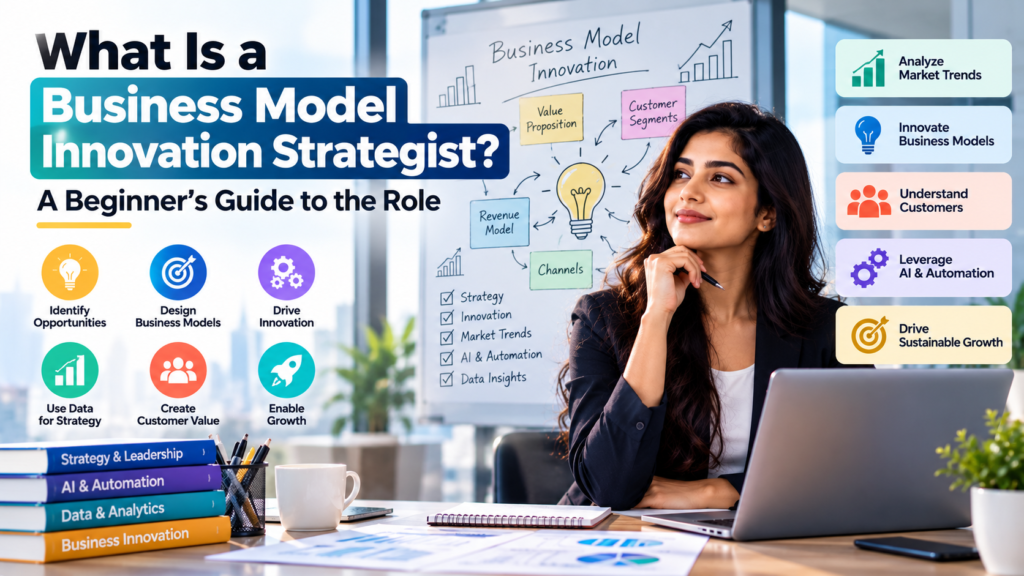
What Is a Business Model Innovation Strategist?
A Business Model Innovation Strategist is a professional who helps organizations rethink and improve the way they create, deliver, and capture value.
A business model includes much more than a company’s product or service.
It can involve:
- Target customers
- Customer needs
- Value proposition
- Revenue sources
- Pricing
- Distribution channels
- Key resources
- Partnerships
- Business operations
- Cost structure
- Customer relationships
A strategist examines these elements together rather than looking at one part of the business in isolation.
For example, a company may have a strong product but an outdated pricing model. Another company may have a good service but struggle to reach customers efficiently.
Business model innovation looks for opportunities to change the structure of the business so it can create greater value.
What Is Business Model Innovation?
Business model innovation means changing the way an organization operates to create new or improved value.
This does not always mean inventing a completely new product.
A business can innovate by changing:
- How it charges customers
- How customers access its service
- How products are distributed
- How technology is used
- How partners contribute to the business
- How customer relationships are managed
- How internal processes are organized
- How revenue is generated
For example, a company that traditionally sells software through a one-time license might move toward a subscription model.
A physical retailer might introduce an online marketplace.
A professional service provider might create a digital self-service platform.
These changes can represent business model innovation even when the underlying expertise or product remains similar.
Why Is Business Model Innovation Important?
Markets can change faster than traditional business planning cycles.
A business that was successful several years ago may face new challenges because of:
- Changing customer expectations
- New competitors
- Digital platforms
- Economic conditions
- Artificial intelligence
- Automation
- New regulations
- Changing purchasing behavior
- Emerging technologies
Business model innovation helps organizations respond to these changes proactively.
Instead of asking only, “How can we improve what we already do?”, businesses can also ask:
“Is there a better way to create and deliver value?”
This shift in thinking can open new opportunities for growth.
What Does a Business Model Innovation Strategist Do?
The responsibilities of a Business Model Innovation Strategist can vary depending on the organization.
However, the role often involves several key activities.
1. Understand the Existing Business Model
Innovation usually starts with understanding the current situation.
A strategist examines areas such as:
- Customer segments
- Products and services
- Revenue streams
- Pricing
- Costs
- Distribution
- Partnerships
- Resources
- Customer experience
The objective is to understand how the business currently creates value and where weaknesses or opportunities exist.
2. Research Customers and Markets
A business model should be connected to real customer needs.
Strategists may study:
- Customer behavior
- Market trends
- Competitor offerings
- Customer feedback
- Industry developments
- Emerging technologies
- Purchasing patterns
This information helps identify gaps between what customers want and what businesses currently provide.
3. Identify New Opportunities
Once the current business model is understood, the strategist looks for potential areas of innovation.
For example:
- New customer segments
- New pricing approaches
- Digital products
- Subscription models
- Platform-based services
- Partnerships
- Automation opportunities
- New distribution channels
Not every idea will become a successful business model. The strategist needs to evaluate ideas carefully before recommending investment.
4. Develop Business Model Concepts
A strategist may create several possible models and compare them.
For example, a company might consider:
Option A: Continue with the existing model.
Option B: Introduce a subscription service.
Option C: Create a digital marketplace.
Option D: Combine the existing service with an AI-powered platform.
Each option can be evaluated based on customer value, revenue potential, costs, risks, resources, and scalability.
5. Use Data to Support Decisions
Business model innovation should not rely entirely on assumptions.
Data can help answer questions such as:
- Which customer segment generates the most value?
- Which products are most profitable?
- Where are customers leaving the sales process?
- Which channels generate the strongest results?
- How sensitive are customers to pricing?
- Which markets are growing?
This is where Data & Analytics becomes an important part of business model strategy.
6. Evaluate Financial and Operational Feasibility
An innovative idea still needs to make business sense.
Strategists may evaluate:
- Revenue potential
- Cost implications
- Required investment
- Profitability
- Resource requirements
- Operational complexity
- Scalability
- Potential risks
A creative concept becomes more valuable when it can realistically be implemented.
7. Work With Leadership and Teams
Business model changes can affect multiple parts of an organization.
A strategist may collaborate with:
- Senior leaders
- Product teams
- Marketing teams
- Sales teams
- Finance teams
- Operations
- Technology teams
- External partners
Strong communication and stakeholder management are therefore important parts of the role.
What Skills Does a Business Model Innovation Strategist Need?
The role requires a combination of analytical, strategic, creative, and communication skills.
Strategic Thinking
A strategist needs to understand how individual business decisions connect to broader organizational goals.
They should be able to think about both short-term opportunities and long-term consequences.
Business Analysis
Understanding revenue, costs, customers, competition, and market conditions helps strategists evaluate potential business models.
Customer-Centric Thinking
Innovation should solve meaningful customer problems.
Understanding customer needs, frustrations, motivations, and behavior can help organizations develop stronger value propositions.
Creative Problem-Solving
Business model innovation often requires exploring ideas that are different from the organization’s existing approach.
Strategists need to generate alternatives rather than automatically accepting the current way of working.
Data Literacy
Strategic decisions increasingly depend on evidence.
A strategist should be comfortable interpreting reports, market information, customer data, financial metrics, and performance indicators.
Communication
An innovative idea is difficult to implement if stakeholders cannot understand its value.
Strategists need to communicate ideas clearly to both technical and non-technical audiences.
Leadership and Collaboration
Business model changes often require organizational alignment.
The ability to influence teams, manage discussions, explain trade-offs, and build support can be just as important as analytical skills.
How AI Is Changing Business Model Innovation
Artificial intelligence is becoming an important factor in business strategy.
AI can change not only how businesses perform tasks but also how they deliver value to customers.
For example, AI can enable:
- Personalized customer experiences
- Automated support
- AI-powered products
- Intelligent recommendations
- Predictive services
- Automated workflows
- Faster content production
- Data-driven decision-making
This means strategists increasingly need to consider AI when evaluating future business models.
A useful question is not simply:
“Where can we use AI?”
A stronger strategic question is:
“How could AI change the way our business creates and delivers value?”
That distinction moves the conversation from technology adoption toward business model innovation.
AI and Business Model Innovation: An Example
Imagine a traditional consulting company that charges clients based on hours worked.
A Business Model Innovation Strategist could explore several alternatives.
The company might introduce:
- Subscription-based advisory services
- AI-assisted self-service tools
- Digital assessment products
- Automated reporting
- Hybrid human-and-AI consulting
- Industry-specific platforms
The objective would not be to replace the existing service simply because AI is available.
Instead, the strategist would evaluate whether AI could create a better customer experience, improve efficiency, expand market reach, or create a new source of revenue.
The Role of Data & Analytics
Data provides evidence for strategic decisions.
A Business Model Innovation Strategist can use analytics to understand:
- Customer lifetime value
- Revenue by segment
- Product performance
- Customer acquisition costs
- Retention
- Conversion rates
- Market growth
- Operational performance
For example, if data shows that a small customer segment generates a disproportionately large share of revenue, the business may decide to develop a specialized offering for that segment.
Without data, the idea may remain a hypothesis.
With data, the organization can investigate whether the opportunity is worth pursuing.
Business Model Innovation and Strategy & Leadership
Innovation is not only about generating ideas.
Someone needs to decide which ideas deserve investment, align teams around priorities, manage uncertainty, and guide implementation.
This is why Strategy & Leadership is closely connected with business model innovation.
Strategic leaders need to balance:
Opportunity + Evidence + Resources + Risk + Execution
A highly creative idea may fail if the organization lacks the resources to implement it.
Similarly, a low-risk idea may have limited growth potential.
A strong strategist evaluates both possibilities and constraints.
Business Model Innovation vs Product Innovation
These concepts are related but different.
Product innovation focuses primarily on improving or creating products and services.
Business model innovation looks at the broader system through which a business creates and captures value.
For example, a company might launch a new product without changing how it sells or delivers its offerings.
Another company might keep the same core product but introduce a subscription model, digital distribution, new customer segment, or platform strategy.
The second example represents business model innovation.
Who Can Become a Business Model Innovation Strategist?
This skill set can be useful for professionals from different backgrounds, including:
- Business professionals
- Entrepreneurs
- Product managers
- Marketing professionals
- Consultants
- Operations managers
- Project managers
- Strategy professionals
- Digital transformation professionals
- Technology professionals
- Recent graduates
You do not necessarily need to start your career with the title “Business Model Innovation Strategist.”
The skills can be applied within existing roles and can support progression into strategy, innovation, consulting, product, transformation, and leadership positions.
How to Start Learning Business Model Innovation
If you are new to this field, begin with the fundamentals.
Step 1: Understand Business Models
Learn how organizations create, deliver, and capture value.
Understand concepts such as:
- Value propositions
- Customer segments
- Revenue models
- Cost structures
- Channels
- Partnerships
Step 2: Study Customers and Markets
Learn how to identify customer problems, market gaps, changing expectations, and competitive opportunities.
Step 3: Develop Data Skills
Learn how to interpret business metrics and use evidence to evaluate opportunities.
Step 4: Understand Digital and AI Technologies
Explore how AI, automation, platforms, and digital tools can influence business operations and customer experiences.
Step 5: Develop Strategic Thinking
Practice evaluating different business scenarios and considering their long-term implications.
Step 6: Build Innovation Cases
Take an existing business and ask:
- What could be improved?
- What customer problem remains unsolved?
- Could the pricing model change?
- Could technology create a new service?
- Could the business serve another customer segment?
- Could automation reduce unnecessary costs?
This type of practice can help turn theoretical knowledge into strategic thinking.
Is a Business Model Innovation Course Useful for Beginners?
A structured Business Model Innovation Course can help beginners understand how business models work and how organizations can evaluate new opportunities.
A Business Model Innovation Course in India may be relevant for students, entrepreneurs, managers, and working professionals looking to build strategic and innovation skills.
Professionals in the United States can also explore a Business Model Innovation Course in USA to develop knowledge related to strategy, innovation, digital transformation, and business growth.
The most useful learning approach should connect concepts with realistic business scenarios rather than focusing only on theoretical frameworks.
Career Opportunities Related to Business Model Innovation
Business model innovation skills can support several career directions.
Depending on your existing experience, relevant roles may include:
- Business Strategist
- Innovation Strategist
- Business Consultant
- Strategy Analyst
- Product Manager
- Business Development Manager
- Digital Transformation Specialist
- Innovation Manager
- Strategy Consultant
- Entrepreneur
The exact career path depends on your previous education, professional experience, industry knowledge, and additional skills.
Why Business Model Innovation Matters in the AI Era
AI is creating new possibilities for businesses.
Some organizations are using AI to improve existing processes. Others are creating entirely new products, services, and customer experiences around AI.
This means businesses need professionals who can look beyond individual AI tools and understand their strategic implications.
A Business Model Innovation Strategist can help organizations consider questions such as:
- Could AI create a new revenue stream?
- Could automation reduce operating costs?
- Could an existing service become a digital product?
- Could a business reach customers through a new platform?
- Could data create a new source of value?
- Could technology support a different pricing model?
These questions demonstrate why business model innovation is becoming increasingly connected with AI, data, and digital transformation.
Build Future-Ready Strategy Skills With IKON SKILLS™
IKON SKILLS™ focuses on career-oriented Micro-Credentials designed to help professionals develop practical capabilities for a changing workplace.
For learners interested in business model innovation, Strategy & Leadership provides an important foundation for understanding strategic decision-making, leadership, and organizational change.
Business model innovation also connects naturally with AI & Automation and Data & Analytics.
AI & Automation can help professionals understand how emerging technologies can transform products, services, and processes. Data & Analytics can support evidence-based evaluation of markets, customers, and business performance.
Together, these areas can help professionals develop a broader perspective on modern business transformation.
Learners can explore the IKON SKILLS™ Credential Catalog to discover relevant Micro-Credentials and build a learning pathway aligned with their professional goals.
Frequently Asked Questions
What is a Business Model Innovation Strategist?
A Business Model Innovation Strategist helps organizations rethink how they create, deliver, and capture value. The role combines business strategy, innovation, customer understanding, data, technology, and leadership.
What does a Business Model Innovation Strategist do?
They analyze existing business models, study customer and market changes, identify new opportunities, evaluate potential models, and work with stakeholders to support strategic implementation.
Is business model innovation the same as product innovation?
No. Product innovation focuses primarily on creating or improving products and services. Business model innovation considers the broader way a company creates, delivers, and captures value.
Do I need an MBA to work in business model innovation?
An MBA can be useful for certain strategy and consulting careers, but it is not the only way to develop business model innovation skills. Relevant experience, practical learning, analytical ability, and strategic thinking can also be valuable.
How does AI affect business model innovation?
AI can change how organizations deliver services, interact with customers, automate processes, develop products, and generate revenue. Strategists can evaluate these opportunities and determine where AI could create meaningful business value.
Is a Business Model Innovation Course suitable for beginners?
Yes. Beginners can start by learning fundamental business model concepts and gradually develop skills in strategy, innovation, data, AI, and leadership.
Conclusion
A Business Model Innovation Strategist looks beyond the way a business operates today and explores how it could create value differently tomorrow.
The role combines strategic thinking, customer understanding, data, innovation, technology, and leadership.
As AI, automation, and digital platforms continue to reshape industries, businesses need professionals who can recognize new opportunities while also understanding the practical challenges of implementation.
Learning business model innovation can therefore be valuable for entrepreneurs, managers, consultants, product professionals, and anyone interested in strategy and digital transformation.
The most important mindset is to keep asking:
What value are we creating, who are we creating it for, and is there a better way to deliver it?
That mindset is at the heart of business model innovation.
Related Search Terms
- Business Model Innovation Strategist
- business model innovation course
- business model innovation course in India
- business model innovation course in USA
- business model innovation certification
- business strategy course
- business strategy course in India
- business strategy course in USA
- innovation strategy course
- innovation management course
- business model strategy course
- digital transformation course
- AI strategy course
- AI and business strategy course
- AI and automation course
- data analytics course
- strategy and leadership course
- strategic leadership course
- business innovation course
- business model innovation certification in India
- business model innovation certification in USA
- business innovation strategist
- digital business strategy course
- AI business model innovation
- business model innovation for beginners
