
Businesses generate huge amounts of data every day—from sales and customer activity to marketing performance, operations, and financial results. Raw data has limited value until it is analyzed and translated into information that businesses can act on.
This is where the expertise of a business data analyst becomes valuable. They examine business data, identify trends, measure performance, and help teams make informed decisions based on evidence rather than assumptions.
In this guide, we’ll explore what a business data analyst does, the skills they need, the tools they use, career opportunities, and how you can start building a career in this field.
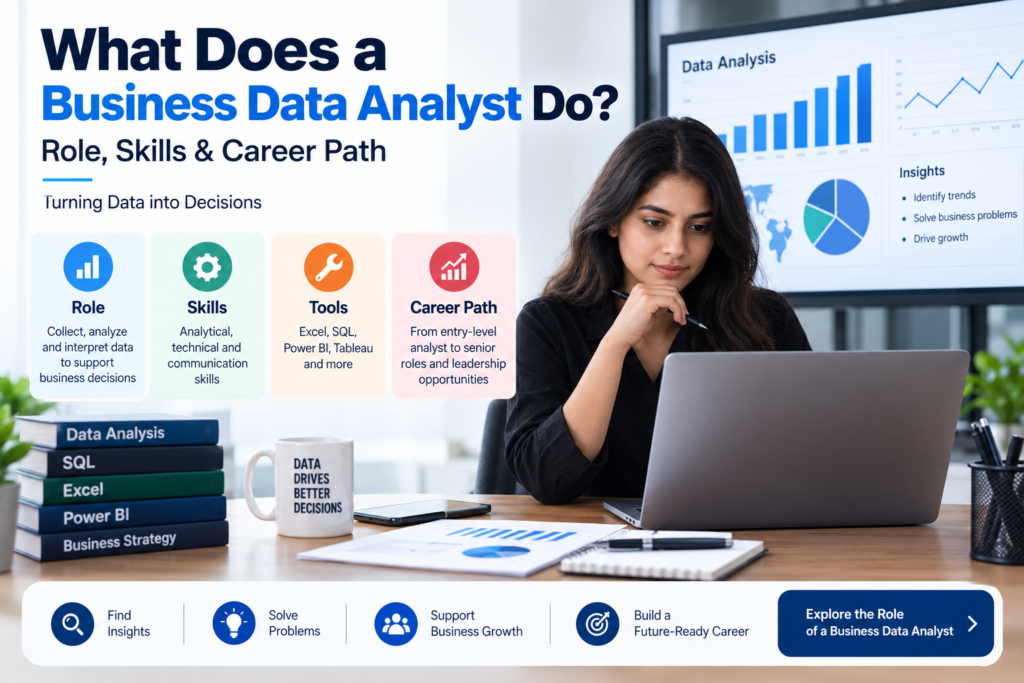
What Is a Business Data Analyst?
Business data Analyst courses examine business information to uncover patterns, evaluate performance, and provide insights that can guide organizational decisions.
They work between business teams and data. Their role is not simply to create reports or work with spreadsheets. They need to understand a business problem, find the relevant data, analyze it, and communicate what the results mean.
For example, a company may notice that its sales have declined. A business data analyst could analyze sales data by product, location, customer segment, and time period to identify where the decline is happening and what factors may be contributing to it.
What Does a Business Data Analyst Do?
A typical business data analyst may:
- Collect and organize business data
- Clean and prepare datasets
- Analyze trends and patterns
- Create reports and dashboards
- Track business performance
- Identify opportunities and potential problems
- Support forecasting and planning
- Work with different business teams
- Present insights to managers and decision-makers
What an analyst works on can differ based on the organization, industry, business needs, and seniority of the position.
Key Responsibilities of a Business Data Analyst
A business data analyst usually works through several stages, from understanding a business question to communicating the final insight.
Understanding Business Problems
Before analyzing data, an analyst needs to understand the actual business question.
For example:
What factors are causing customers to stop purchasing after their initial order?
Instead of immediately looking at every available dataset, the analyst may identify which customer, sales, product, and engagement data could help answer the question.
Collecting and Preparing Data
Business data can come from different sources, including
- CRM systems
- Sales platforms
- Marketing tools
- Customer databases
- Financial systems
- Website analytics
- Surveys
- Operational systems
The analyst may need to combine information from multiple sources before beginning the analysis.
Cleaning Data
Data is not always ready for analysis. It can contain duplicate records, missing values, inconsistent formats, or incorrect entries.
Data cleaning helps improve the reliability of the analysis.
Analyzing Business Data
Once the data is prepared, the analyst looks for meaningful patterns.
This may include examining:
- Sales performance
- Customer behavior
- Revenue trends
- Marketing results
- Product performance
- Operational efficiency
- Customer retention
- Regional performance
The goal is to answer a specific business question rather than simply produce numbers.
Creating Reports and Dashboards
Analysts often convert their findings into easy-to-understand reports and dashboards.
An effective dashboard should make important business information easy for stakeholders to interpret at a glance.
- What is happening?
- Why might it be happening?
- Which areas need attention?
- What should the business investigate next?
Communicating Insights
One of the most important parts of the job is explaining the findings clearly.
A business data analyst may present results to people who do not have a technical background. Therefore, they need to explain data in business language rather than relying on technical terminology.
Which Skills Are Important in Business Data Analysis?
A successful business data analyst needs a combination of analytical, technical, business, and communication skills.
Analytical Thinking
Analytical thinking helps an analyst break a complex business problem into smaller questions and determine what information is needed.
For example, instead of asking only, “Why are sales down?” an analyst might investigate:
- Which products are affected?
- Which regions are affected?
- When did the decline begin?
- Has customer behavior changed?
- Did pricing or promotions change?
SQL
SQL is widely used to retrieve and analyze data stored in databases.
A business data analyst may use SQL to:
- Filter records
- Join datasets
- Group information
- Calculate metrics
- Identify trends
- Build analysis-ready datasets
Excel or Spreadsheet Skills
Spreadsheets remain useful for many business analysis tasks.
Important skills can include:
- Formulas
- Pivot tables
- Data cleaning
- Charts
- Lookups
- Basic statistical analysis
Data Visualization
Analysts need to present information visually so that business users can understand it quickly.
Common visualization tools include
- Power BI
- Tableau
- Looker Studio
- Excel
The tool matters, but the ability to choose the right visualization matters even more.
Business Understanding
Technical skills alone are not enough.
A good analyst should understand how a business operates, including areas such as
- Revenue
- Costs
- Customers
- Marketing
- Sales
- Operations
- Performance metrics
This allows them to connect data findings with real business situations.
Communication Skills
An analyst may discover an important trend, but the insight has little value if stakeholders cannot understand it.
Strong communication helps analysts explain:
- What the data shows
- Why it matters
- What may be causing the change
- What questions should be explored next
Problem-Solving
Business questions are often unclear at the beginning. Analysts need to investigate the available information and determine practical ways to approach the problem.
Data Storytelling
Data storytelling combines analysis, visualization, and communication.
Instead of presenting a page full of numbers, an analyst can build a clear story:
Business problem → Evidence → Insight → Possible action
What Tools Does a Business Data Analyst Use?
The tools depend on the organization and role, but several are commonly used.
Tool Typical Use: Excel Data Analysis, Calculations, and Reporting SQL Querying databases, Power BI dashboards, and business reporting in Tableau Data visualization: Looker Studio Reporting and Dashboard Creation in Python Advanced analysis and automation CRM platforms: customer and sales data Google Analytics website and user behavior analysis
You do not necessarily need to master every tool before starting. It is usually more useful to develop strong fundamentals and then learn tools that match the type of work you want to do.
Business Data Analyst vs. Data Analyst
The two roles can overlap significantly, but their focus can be different.
Business Data Analyst Often focuses strongly on business problems May work across broader analytical problems Connects data with business decisions Focuses heavily on analyzing and interpreting data Works closely with business stakeholders May work with technical and business teams Often tracks business KPIs May work with a wider range of datasets Business context is particularly important. Technical analysis may be more prominent depending on the role.
There is no universal distinction between the two job titles. Companies can define these roles differently.
What Is a Typical Day Like for a Business Data Analyst?
A typical day can vary considerably.
For example, an analyst might start the morning reviewing a performance dashboard and checking whether important business metrics have changed.
Later, they may use SQL to investigate a drop in customer conversions. They could then create a report, discuss the findings with the marketing team, and prepare recommendations for management.
A typical workflow might look like this:
Business question → Data collection → Data preparation → Analysis → Visualization → Insight → Business discussion
This combination of technical and business work is what makes the role different from purely technical data positions.
How to Become a Business Data Analyst
You do not necessarily need to learn everything at once. A structured learning approach can make the process easier.
Step 1: Learn Business and Data Fundamentals
Start by understanding basic business concepts and how organizations use data.
Learn about:
- KPIs
- Revenue
- Customer metrics
- Conversion rates
- Profitability
- Business performance
Step 2: Build Strong Excel Skills
Become comfortable working with spreadsheets and basic data analysis.
Practice using real-world datasets rather than only following tutorials.
Step 3: Learn SQL
SQL is an important skill for working with structured business data.
Start with basic queries and gradually move into joins, aggregations, subqueries, and more advanced analysis.
Step 4: Learn Data Visualization
Choose one visualization platform, such as Power BI or Tableau, and learn how to create useful dashboards.
Focus on communicating insights rather than simply making dashboards look attractive.
Step 5: Practice Business Case Studies
Work on practical questions such as
- Why did sales decrease?
- Which customer segment generates the most revenue?
- Which marketing channel performs best?
- Which products have the highest growth?
- At which stage of the customer journey are potential buyers losing interest?
Step 6: Build a Portfolio
Create a few practical projects that demonstrate your ability to solve business problems using data.
A portfolio could include:
- Sales analysis
- Customer segmentation
- Marketing performance analysis
- Product performance dashboard
- Customer retention analysis
Step 7: Develop Communication Skills
Practice explaining your findings in simple business language.
Being able to explain what the data means and why it matters can be just as important as performing the analysis.
What Is the Career Path for a Business Data Analyst?
A business data analyst can progress into different analytical and business-focused roles depending on their interests and experience.
A possible career path is
Junior Business Data Analyst → Business Data Analyst → Senior Business Data Analyst → Analytics Manager
With additional experience, some professionals may move toward roles such as
- Business Intelligence Analyst
- Data Analytics Manager
- Product Analyst
- Business Intelligence Manager
- Analytics Consultant
- Data Strategy Professional
Career progression is not always linear. The direction you take will depend on your technical skills, business knowledge, industry experience, and career goals.
Is Business Data Analysis a Good Career?
Business data analysis can be a strong career option for people who enjoy working with numbers but also want to understand how businesses operate.
The role combines several areas:
Data + Business + Technology + Problem-Solving + Communication
It can also provide opportunities to work across different industries because organizations in areas such as finance, healthcare, retail, technology, education, and marketing all use data to support decisions.
However, the field is also changing. Analysts increasingly need to work with automation, AI-assisted analytics, and larger volumes of data. Developing adaptable skills can therefore be valuable over the long term.
How Is AI Changing Business Data Analysis?
AI engineer Course is increasingly being used to support different parts of the analytical workflow.
For example, AI-assisted tools can help with:
- Exploring datasets
- Generating initial queries
- Identifying patterns
- Creating summaries
- Supporting data visualization
- Automating repetitive tasks
However, analysts still need to validate results and understand the business context.
An AI-generated insight should not automatically be treated as correct. Analysts need to check the underlying data, assumptions, calculations, and business relevance before presenting conclusions.
What Makes a Good Business Data Analyst?
A good business data analyst is not simply someone who knows SQL, Excel, or a visualization tool.
They should be able to connect business questions with reliable evidence.
Strong analysts tend to:
- Ask the right questions
- Check data quality
- Think critically about results
- Understand business objectives
- Avoid jumping to conclusions.
- Communicate clearly
- Focus on actionable insights
The most valuable skill is often knowing which question to ask before deciding which data to analyze.
Frequently Asked Questions
What does a business data analyst do?
A business data analyst analyzes business data to identify trends, measure performance, answer business questions, and provide insights that support better decision-making.
What skills do you need to become a business data analyst?
Important skills include Excel, SQL, data visualization, analytical thinking, business knowledge, problem-solving, communication, and data storytelling.
Is SQL necessary for a business data analyst?
SQL is an important skill for many business data analyst roles because it allows professionals to retrieve and analyze information from databases. However, the exact technical requirements vary by employer.
What tools should a business data analyst learn?
Common tools include Excel, SQL, Power BI, Tableau, Looker Studio, and sometimes Python. The best tools to learn depend on the role and industry you want to work in.
What is the difference between a business data analyst and a data analyst?
Both roles analyze data, but a business data analyst typically has a strong focus on business problems and decision-making. The distinction varies between organizations, so job descriptions should be checked carefully.
Can a beginner become a business data analyst?
Yes. Beginners can build toward the role by learning data fundamentals, Excel, SQL, visualization, and business concepts, followed by practical projects that demonstrate their skills.
Do business data analysts need programming skills?
Not every business data analyst role requires advanced programming. SQL is commonly useful, while Python can be valuable for more advanced analysis and automation.
Is a degree required to become a business data analyst?
Requirements vary between employers. Some positions may ask for a degree, while others place greater emphasis on practical skills, relevant experience, certifications, and demonstrated project work.
Final Thoughts
A business data analyst helps organizations turn business data into useful information for decision-making. The role combines analytical thinking with business understanding, technical skills, and clear communication.
If you are starting from scratch, focus on building the fundamentals first: Excel, SQL, data visualization, business knowledge, and practical problem-solving. Then strengthen your skills through real-world projects and gradually add more advanced analytics and AI-assisted tools.
The goal is not simply to analyze data. The goal is to use data to understand a business problem and help people make better decisions.

Comments (2)
[…] digital transformation course may cover digital strategy, AI, automation, data analytics Course, cloud computing, technology adoption, business processes, and organizational […]
[…] examples, experience, opinions, data Analytics, and original […]