
What Is a Brand Identity Architect?
A brand is often introduced through a logo, color palette, website, or social media profile. But a strong brand is much bigger than its visual appearance.
It represents what a company stands for, how it communicates, how customers experience it, and what people remember about it.
A Brand Identity Architect helps bring these different elements together.
In simple terms, a Brand Identity Architect Course is a professional who develops and guides the strategic, visual, verbal, and experiential elements that shape how a brand is recognized and understood.
The role sits at the intersection of brand strategy, creativity, customer understanding, communication, and business objectives.
Instead of asking only, “What should our logo look like?”, a Brand Identity Architect asks broader questions:
- What does the brand stand for?
- Who is the brand trying to reach?
- What makes the brand different?
- How should customers perceive it?
- What should the brand sound like?
- How should the brand appear across different platforms?
- How can the identity remain consistent as the business grows?
This is why brand identity architecture is an important part of modern brand management.
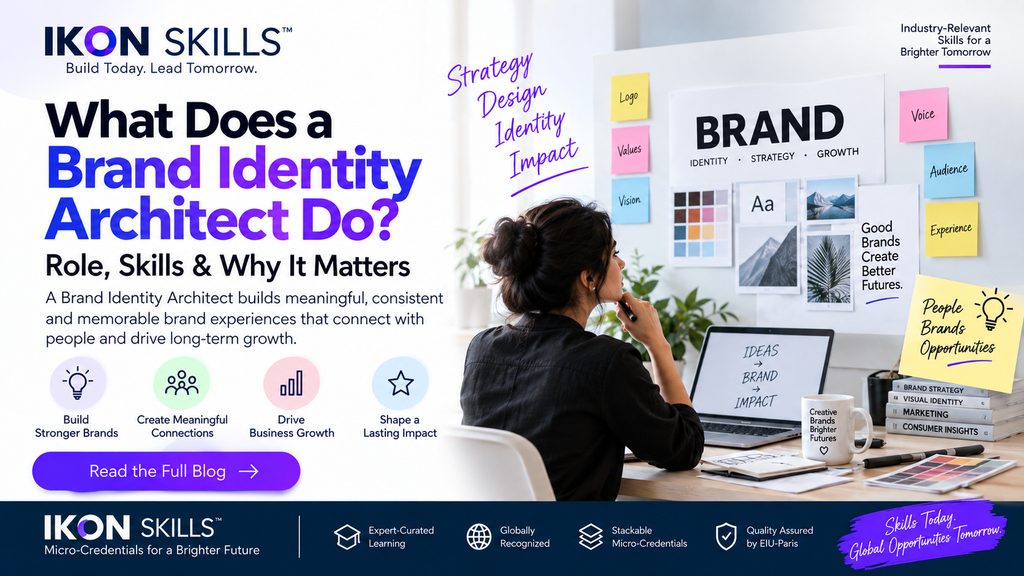
What Does a Brand Identity Architect Do?
The exact responsibilities can vary depending on the organization. A startup may expect one person to handle several branding responsibilities, while a larger company may have separate teams for brand strategy, design, research, content, and marketing.
Some common responsibilities include the following.
1. Define the Brand Identity
A Brand Identity Architect helps establish the foundation of the brand.
This may include:
- Brand purpose
- Brand vision
- Brand values
- Brand personality
- Brand positioning
- Target audience
- Brand promise
- Communication style
A clear brand identity strategy helps different teams communicate consistently.
2. Research the Target Audience
A brand should not be designed only around what a company wants to say.
The professional also needs to understand the people the brand is trying to reach.
Research can include:
- Customer preferences
- Buying behavior
- Customer expectations
- Competitor positioning
- Market trends
- Customer feedback
- Cultural differences
This research can provide useful consumer insights for brand decisions.
3. Develop Brand Positioning
Brand positioning describes how a business wants to be understood in relation to competitors.
For example, a company could position itself around:
- Innovation
- Affordability
- Premium quality
- Convenience
- Sustainability
- Expertise
- Customer experience
A Brand Identity Architect helps ensure that the brand’s identity supports the chosen positioning.
4. Guide the Visual Identity
Visual identity is one of the most recognizable parts of a brand.
A Brand Identity Architect may guide:
- Logo usage
- Colors
- Typography
- Photography
- Illustration
- Icons
- Packaging
- Website design
- Social media visuals
The objective isn’t simply to make something attractive. The visual system should communicate the brand consistently.
5. Develop Brand Voice and Messaging
A recognizable brand needs a recognizable way of communicating.
A brand voice influences:
- Website content
- Social media posts
- Advertisements
- Email campaigns
- Product descriptions
- Customer communication
- Corporate messaging
For example, a financial brand may use a professional and reassuring voice, while a youth-focused consumer brand may use a more conversational tone.
6. Create Brand Guidelines
As organizations grow, more people become involved in creating content and marketing materials.
Without clear guidelines, different teams may unintentionally communicate the brand differently.
A brand style guide can define:
- Logo rules
- Color usage
- Typography
- Photography
- Visual elements
- Tone of voice
- Messaging principles
- Digital applications
This makes brand consistency easier to maintain.
Why Does Brand Identity Matter?
Think about a company you recognize immediately when you see its colors, design style, or communication.
That recognition doesn’t happen by accident.
A consistent brand identity helps create familiarity across different customer touchpoints.
It can support:
- Brand recognition
- Consistent communication
- Customer trust
- Market differentiation
- Customer experience
- Marketing effectiveness
- Long-term brand value
However, brand identity should not be viewed only as a design exercise.
It connects business strategy, customer understanding, communication, marketing, and experience.
What Is the Difference Between Brand Identity and Brand Image?
These terms are often used together, but they describe different ideas.
Brand Identity
Brand identity is how an organization intentionally defines and presents itself.
It includes:
- Values
- Personality
- Visual identity
- Messaging
- Voice
- Positioning
Brand Image
Brand image is how customers actually perceive the organization.
For example, a company might describe itself as innovative and customer-focused. But if customers have poor experiences, their perception may be very different.
This is why a Brand Identity Architect needs to think about both the identity the company creates and the experience customers receive.
What Skills Does a Brand Identity Architect Need?
A successful Brand Identity Architect needs more than creative ability.
The role combines strategic thinking, research, communication, creativity, and an understanding of customers.
1. Brand Strategy
Understanding brand strategy is fundamental.
A professional should understand how positioning, purpose, values, audience, messaging, and identity work together.
2. Consumer Research
Understanding customers is essential for building relevant brands.
Useful skills include:
- Customer research
- Market research
- Competitor analysis
- Consumer behavior
- Customer segmentation
3. Strategic Thinking
A Brand Identity Architect needs to connect branding decisions with broader business objectives.
For example:
How will this identity support the company’s market position?
That requires more than visual creativity.
4. Creative Thinking
Branding requires original ideas, but creativity should have a strategic purpose.
The strongest ideas are usually those that are both distinctive and relevant to the audience.
5. Visual Communication
A professional should understand the fundamentals of:
- Typography
- Color
- Layout
- Imagery
- Design systems
- Visual hierarchy
They do not necessarily need to be a full-time graphic designer.
6. Communication Skills
Brand identity projects often involve multiple stakeholders.
A Brand Identity Architect may need to explain ideas to:
- Founders
- Marketing teams
- Designers
- Executives
- Sales teams
- Content teams
- External agencies
Being able to explain the reasoning behind a branding decision is therefore valuable.
7. Digital Branding
Modern brands operate across multiple digital environments.
A digital brand identity may appear on:
- Websites
- Social media
- Search
- Mobile applications
- Digital advertising
- E-commerce platforms
- Video
The identity needs to remain recognizable across these different experiences.
8. Data and Analytics
Brand decisions can also benefit from evidence.
Professionals may review:
- Customer feedback
- Website analytics
- Social media performance
- Brand surveys
- Campaign results
- Customer behavior
Data doesn’t replace creativity. It helps inform strategic decisions.
Brand Identity Architect vs. Brand Strategist
The two roles can overlap, but they often have different areas of emphasis.
| Brand Identity Architect | Brand Strategist |
|---|---|
| Develops the identity system | Develops broader brand strategy |
| Guides visual and verbal identity | Defines positioning and strategic direction |
| Creates identity frameworks | Establishes strategic priorities |
| Focuses on brand expression | Focuses on brand direction |
| Maintains identity consistency | Connects brand strategy with business goals |
In smaller organizations, one person may perform responsibilities from both roles.
Brand Identity Architect vs. Graphic Designer
A graphic designer primarily focuses on visual communication and design assets.
A Brand Identity Architect generally works at a broader level.
A designer might create a logo.
The Brand Identity Architect considers:
- Why does the logo represent the brand?
- How should the logo work with the color system?
- What typography should support it?
- How should the identity appear on social media?
- How should it work on packaging?
- How should customers recognize the brand across different touchpoints?
This is why brand identity design and graphic design can work together without being the same discipline.
Brand Leadership and Brand Identity: What’s the Connection?
Building a recognizable brand requires more than creating guidelines.
Someone also needs to ensure that the organization actually leads the brand consistently.
This is where brand leadership becomes important.
Brand leadership involves connecting brand purpose and strategy with the people, decisions, communication, and customer experiences that shape the organization.
A Brand Identity Architect may therefore work closely with brand leaders to ensure that the identity is reflected throughout the business.
For professionals interested in moving beyond execution into strategic brand roles, developing brand leadership skills can be a valuable next step.
Brand Identity and Brand Leadership in the USA
The brand identity industry in the USA includes organizations across technology, retail, healthcare, education, financial services, hospitality, entertainment, professional services, and many other sectors.
Professionals interested in brand identity careers in the USA can develop skills in:
- Brand strategy
- Brand leadership
- Brand positioning
- Consumer insights
- Digital branding
- Brand communication
- Brand research
- Customer experience
Professionals working with international organizations may also need to understand how a brand should remain consistent while adapting its communication to different audiences.
Brand Identity and Brand Leadership in India
India’s business environment includes startups, technology companies, consumer brands, e-commerce businesses, education organizations, financial services companies, and established enterprises.
This creates different opportunities for professionals developing brand identity skills in India.
A professional interested in brand leadership in India may benefit from understanding:
- Brand strategy
- Consumer behavior
- Brand positioning
- Digital marketing
- Brand communication
- Customer experience
- Market research
- Brand performance
India’s diverse languages, regions, cultures, and customer segments also make audience understanding particularly important for brands operating across the country.
How AI Is Changing Brand Identity and Brand Leadership
AI is becoming part of modern marketing and creative workflows.
It can help professionals with:
- Research
- Idea generation
- Customer feedback analysis
- Content variations
- Trend analysis
- Creative exploration
- Brand knowledge management
However, AI should support strategic judgment rather than replace it.
A tool can generate a logo concept or marketing message in seconds. It cannot automatically determine whether that concept genuinely represents the organization’s purpose, positioning, audience, and values.
That decision still requires human judgment.
This is particularly important for AI-assisted brand strategy and AI brand leadership.
How to Become a Brand Identity Architect
There isn’t one mandatory route into this career.
A practical pathway can look like this.
Step 1: Learn Brand Fundamentals
Start with:
- Brand identity
- Brand strategy
- Brand positioning
- Brand personality
- Brand communication
- Customer experience
Step 2: Develop Consumer Research Skills
Learn how to understand:
- Target audiences
- Customer behavior
- Competitors
- Market trends
- Customer expectations
Step 3: Learn Visual Identity
Develop an understanding of typography, color, imagery, layout, and design systems.
Step 4: Develop Digital Branding Skills
Learn how brands work across:
- Websites
- Social media
- Search
- Advertising
- E-commerce
Step 5: Develop Brand Leadership Skills
Learn how brand decisions connect with organizational strategy, people, communication, and customer experience.
Step 6: Build a Portfolio
A portfolio could include:
- Brand identity projects
- Brand positioning exercises
- Brand guidelines
- Consumer research
- Brand strategy presentations
- Digital branding projects
- Brand campaign concepts
A practical portfolio helps demonstrate what you can actually do.
Should You Take a Brand Leadership Course?
If you want to move from executing marketing activities toward managing brand direction, a Brand Leadership Course can provide structured learning around strategy, positioning, consumer understanding, communication, and brand management.
For professionals searching online, there are several types of learning options, including:
- Online courses
- Professional certifications
- Micro-Credentials
- University programs
- Self-paced learning
- Short-term professional courses
The right choice depends on your career goals, available time, budget, and the depth of learning you need.
Brand Leadership Course in India
Professionals searching for a Brand Leadership Course in India may include marketing executives, brand managers, entrepreneurs, digital marketers, communication professionals, and business owners.
When comparing a brand leadership course in India, look beyond the course title.
Check whether the curriculum covers:
- Brand strategy
- Brand positioning
- Consumer insights
- Brand communication
- Brand identity
- Brand research
- Digital branding
- Customer experience
- Leadership
- Practical projects
A course that connects brand strategy with real-world application can be more useful than one that focuses only on terminology.
Online Brand Leadership Courses
An online brand leadership course can be useful for professionals who are working full-time or who want to learn without attending a physical classroom.
Online learning can provide flexibility for learners in both India and the USA.
Before enrolling in an online brand leadership course, consider:
- Course curriculum
- Learning format
- Assessment method
- Practical assignments
- Credential or certification
- Instructor expertise
- Learning duration
- Cost
- Whether the skills match your career objective
Don’t choose a course simply because it appears first in search results.
What About Free Course Websites and Free Course Platforms?
Many learners begin their search with phrases such as free course website, free online course platform, or brand leadership free course platform.
Free learning resources can be a useful starting point, particularly when you are exploring a new subject.
However, there is an important difference between free educational content and a structured professional learning program.
A free course may provide introductory knowledge, while a professional program may include:
- Structured curriculum
- Assessments
- Practical projects
- Feedback
- Skills verification
- A recognized credential
If your objective is simply to understand brand leadership basics, a free course platform can be a reasonable starting point.
If your objective is to demonstrate professional capability, compare the curriculum, assessment, credential, and practical outcomes before choosing.
Free Brand Leadership Course: What Should You Look For?
If you search for a free brand leadership course, don’t evaluate the course only because it costs nothing.
Look for content covering areas such as:
Brand Strategy
Does the course explain how brands develop their strategic direction?
Brand Positioning
Does it explain how businesses differentiate themselves?
Consumer Insights
Does it teach you how to understand customers?
Brand Communication
Does it explain how brand messages should be developed?
Brand Identity
Does it connect visual and verbal identity with strategy?
Leadership
Does it explain how leaders maintain brand consistency across an organization?
This approach helps you distinguish a genuinely useful free brand leadership course from a basic collection of videos or articles.
Brand Leadership Learning With IKON Skills™
For professionals looking for skills-based learning, IKON Skills™ offers Micro-Credentials across the broader Brand Leadership domain.
Relevant options include:
- Brand Identity Architect
- Brand Strategist
- Brand Positioning Expert
- Brand Communications Specialist
- Digital Brand Specialist
- Consumer Insights Analyst
- Brand Performance Analyst
- Brand Research Specialist
- Brand Experience Designer
- Brand Equity Analyst
- Brand Campaign Manager
- AI Brand Strategist
- Customer-Centric Brand Strategist
- Brand Leader
- Global Brand Director
- Chief Brand Officer
The Brand Identity Architect Micro-Credential is particularly relevant for professionals who want to build skills around the strategic and practical development of brand identity.
For someone searching for a brand leadership online course, brand leadership course in India, or a skills-focused alternative to a traditional course, Micro-Credentials can be considered alongside other learning formats.
Who Should Learn Brand Leadership?
Brand leadership skills can be useful for:
- Brand managers
- Marketing managers
- Digital marketers
- Entrepreneurs
- Startup founders
- Advertising professionals
- Creative professionals
- Content strategists
- Social media professionals
- Brand consultants
- Business owners
- Communication professionals
It can also be useful for professionals who want to progress from executing campaigns to taking greater responsibility for brand direction.
Frequently Asked Questions
What does a Brand Identity Architect do?
A Brand Identity Architect develops and guides the strategic, visual, and verbal elements that shape how a brand is recognized and experienced.
What skills does a Brand Identity Architect need?
Important Brand Identity Architect skills include brand strategy, consumer research, positioning, creative thinking, visual communication, digital branding, communication, and analytical thinking.
Is Brand Identity Architecture the same as graphic design?
No. Graphic design primarily focuses on visual communication, while Brand Identity Architecture generally considers the wider strategic and identity system.
What is a Brand Leadership Course?
A Brand Leadership Course teaches concepts related to brand strategy, positioning, communication, consumer understanding, identity, and leadership.
Is there a Brand Leadership Course in India?
Yes, professionals can find different learning formats in India, including online programs, professional courses, certifications, and skills-based credentials. Compare the curriculum and outcomes before choosing one.
Is an online brand leadership course useful?
An online brand leadership course can be useful for professionals who need flexible learning while working or studying.
Where can I find a free brand leadership course?
Learners can explore a free course website or free course platform for introductory brand leadership material. However, check whether the resource includes structured learning, assessments, and practical work if you need professional skill development.
Can a digital marketer become a Brand Identity Architect?
Yes. Digital marketing provides useful foundations in audiences, messaging, content, campaigns, and customer behavior. Additional training in brand strategy, identity, positioning, and consumer research can broaden that skill set.
Is Brand Leadership useful for professionals in the USA?
Yes. Brand leadership skills in the USA can be relevant across industries including technology, retail, education, healthcare, financial services, professional services, and consumer brands.
Is Brand Leadership useful for professionals in India?
Yes. Brand leadership skills in India can be relevant to marketers, brand managers, entrepreneurs, digital professionals, and business leaders working across startups, enterprises, e-commerce, education, technology, and consumer businesses.
Conclusion
A Brand Identity Architect does much more than create a logo or choose a color palette.
The role connects brand strategy, identity, positioning, consumer insights, communication, digital branding, and customer experience.
As businesses compete across increasingly crowded digital markets, having a recognizable and consistent brand can become an important part of how customers understand an organization.
For professionals in the USA and India, developing brand identity skills alongside brand leadership skills can open pathways across marketing, branding, creative strategy, consumer insights, and business leadership.
If you’re just starting, a free brand leadership course or free online course platform can help you explore the fundamentals. If you’re looking to build professionally demonstrable skills, compare structured online brand leadership courses, certifications, and Micro-Credentials based on curriculum, assessment, practical application, and relevance to your career.
The goal isn’t simply to learn how to make a brand look good.
It’s to understand why a brand should look, sound, and behave the way it does—and how that identity can be led consistently across an organization.

Comment (1)
[…] course in India, an AI-Assisted Content Marketing course in USA, or programs available through an online course platform based on curriculum, practical application, assessment, and […]